


I was shocked to hear that this past week, a couple of Jehovah’s Witnesses were stationed at one of the exits from our children’s schoolyard. They were giving away copies of their book, What Does the Bible Really Teach? Little did they know that I have written a book in response to that very book.
I must confess that I was not very impressed that this took place. In fact, I was happy to see the principal of the school standing by that gate the very next day.
Why would it bother me that these JWs were giving religious literature to the children? It was not just because I happen to disagree with JW theology. I am a Baptist and I would not want to see Baptist trying to convert children as they are leaving school.
Don’t get me wrong, I am not against religious instruction to children. I strongly disagree with Richard Dawkins when he describes religious instruction to children as being child abuse. There is a place to speak to children about religion, but it is not like what the JWs were doing.
Aside from peer-to-peer discussions about religion, I think any other religious conversations require some sort of permission from the parents. When we send our children to Vacation Bible School or Christian Camp, we are assuming they will talk to our children about God. But we would not want any type of religious persuasion taking place in other contexts without our permission.
But what if the parents are strict atheists and do not want their children taught about God? Shouldn’t religious people seek ways to bypass the parents?
Absolutely not. Ignoring the wishes of parents or even assuming the parents permission, will only damage the family’s openness to God. I suspect that parents who are strongly against religion will find their children seeking out religion out of curiosity.
I believe that religious conversations between people of different religions and people of no religions are good things. But there are ways that these conversations should take place. Adults preying on unsuspecting children at a schoolyard gate is not one of them.
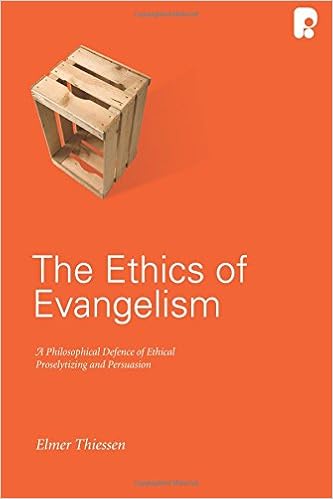 One of the best books that I have read on evangelism is The Ethics of Evangelism by Elmer Thiessen. (USA) (Canada) I highly recommend it.



It’s the deliberate nature of it that gets me. It’s one thing for my kid to go to a friend’s house and see a tract lying about, asking about it, and for an unplanned conversation about the friend’s faith to arise organically from that. It’s something quite different for a group to deliberately position themselves so that they can access children without their parents permission – or even knowing.
There’s something intensely skeevy about that, about the deliberate attempt to go behind parents’ back to access their children. And the skeeviness is in no way dependent on the purpose being religious proselytism.
Very well said.