


2 Books on Theistic Evolution
I have been doing some research on the intersection of faith and science. This has led me to read on human origins. I would like to talk about two books that I recently read on theistic evolution.
What is theistic evolution? It is also called evolutionary creationsim. It basically is a view that the basic principles of the neo-Darwinian synthesis are accurate in describing the development of life on earth. But in contrast to Darwinians such as Richard Dawkins, these scientists believe that there is a God and that he is involved somehow.
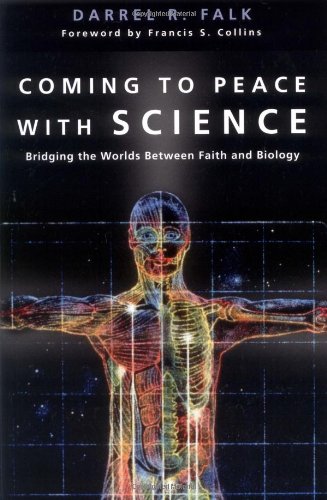 The first book that I read was Coming to Peace With Science by Darrel R. Falk. I really enjoyed this book. As a non-scientist, many of these books leave me scratching my head. But Falk has a nice style that is easy to understand.
Falk interacts with both young earth creationists and intelligent design theories. While disagreeing with them, he speaks very respectfully of their views.
In this book, Falk provides a convincing argument for an old universe and an old earth. He then switches to arguments for evolution. What I liked about Falk is that he actually speaks about God. While not giving details of what exactly God was doing, either to create first life or start the evolutionary process, he does mention God’s presence being essential.
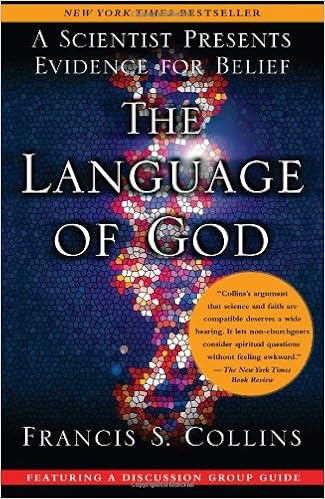 The second book I read was the Language of God by Francis Collins. Collins is a bit better known than Falk, having been the head of the Human Genome Project.
I suppose it is not quite accurate to say this is a book about theistic evolution. It is really about why Collins, as a scientist and a former atheist, is now a committed Christian.
For Collins, the most convincing arguments are the existence of a life permitting universe, the moral argument and the universal longing for God.
Collins does not look to the beginning of life on earth as evidence for God. While we do not know how it began yet, he sees giving God the credit as being a god-of-the-gaps argument. We may discover how it could have happened naturally and that may later prove an embarrassment for those claiming it was God.
There were things that I liked about Collins’s book. I appreciated his personal story and enjoyed the story of the mapping of the genome and all comes from that.
But there were things that I didn’t like. He does not want to go to the beginning of life or the development of life on earth as reflecting God’s activity. He totally rejects the design argument on the biological side.
However, he accepts similar types of arguments on the cosmological side. He sees the existence of and fine-tuning of the universe as pointing to a Creator. His arguments against biological design could also be used against what he says about cosmological design.
I happen to believe that God is the originator and designer of both, but that’s just me.
While I have no problem with people believing in theistic evolution, I have a few questions.
- What role did God have in the first life on earth?
- Was God responsible for it or was it just a “lucky” break that he got to share his universe with other living beings?
- Why does evolution work?
- Does evolution need God or does it work just fine by itself?
- Did God create or design that first life in such a way that it could evolve into all the lifeforms we see?
- Did God have the goal of humans evolving or was that just the way it happened to be and God just dealt with it?
If you are a theistic evolutionist, I would love to hear your thoughts on these questions.



Good questions; thanks for asking. Incidentally, I had a similar reaction to Collins’ book.
I’m going to answer your questions in a different order because I think the answers will make more sense that way.
Does evolution need God or does it work just fine by itself?
Impossible to say. We don’t know what a universe without God would look like; we don’t even know if a universe without God is possible. I don’t believe a supernatural/natural distinction, where we say supernatural is what God does and natural is what happens when God leaves creation to its own devices, is helpful or even possible. I also don’t believe it is Biblical. The Bible doesn’t just ascribe the miraculous and inexplicable to God, but also the regularities of everyday life such as sunrises and human development. When we develop a mechanistic model like gravitation or developmental genetics, we are describing how God creates and also how nature responds to God.
I would say that God always has an intention for his creation and is always creating by expressing that intention, and that creation has an opportunity to respond positively or negatively to that expression of intent; creation can always cooperate or defect. Thus God is always behaving consistently and with intent, but the end result may not always reflect that intent. Evolution is one aspect of that process; evolution is the end result of God constantly creating and creation responding to his expressed intent. It is not a mixture of God sometimes acting and sometimes leaving creation to its own devices, or God setting up some initial conditions and then observing what unfolds.
What role did God have in the first life on earth?
Same as with all life; he created and sustained it. We may very well be able one day to describe the chemistry and physics involved in ultimately producing biology, consistent with how we can describe the physics, chemistry and biology involved in all subsequent life. The first life did not involve some discontinuity in God’s activity, a distinct or special act that was somehow different from how he otherwise interactions with creation.
Did God create or design that first life in such a way that it could evolve into all the lifeforms we see?
Since all life we currently see did evolve from that first life under an evolutionary model, that first life must have had such potential. Given my account of God’s creative activity there are only two options for how it acquired that potential: either God intended such potential, or that potential arose despite God’s intentions otherwise. The testimony of the Bible is that God intended the diversity of life we currently see, so I’m inclined to say God intended this potential. Especially notable is the command to be fruitful and multiply, which would almost certainly result in greater diversity of life.
Was God responsible for it or was it just a “lucky” break that he got to share his universe with other living beings?
Did God have the goal of humans evolving or was that just the way it happened to be and God just dealt with it?
These questions are similar to preceding ones, or at least my answers are. Was God responsible in the sense that it wouldn’t have happened without him? We can’t really answer that one. Was God responsible in the sense that life arose in response to his intentions and creative activity? Yes. Did God intend humans? Again, I think the Bible suggests that God intended some sort of creature who could bear his image, and humans satisfy that intention.
Why does evolution work?
This is a rich question with many possible answers. Because God made it fruitful. Because DNA replication is not 100% accurate. Because genomes producing viable organisms are dense in the space of all possible organisms. Because phenotypes are not fully determined by genotypes. Because dynamical systems with feedback loops tend toward the edge of chaos. Because amino acid chains are substrates for and catalysts of a versatile set of chemical reactions. And so on.
Do any of these answers approach what you were looking for? If not, can you elaborate on your question?