


Answering Jihad: A Better Way Forward
Nabeel Qureshi, Answering Jihad: A Better Way Forward (Grand Rapids: Zondervan, 2016), Pbk. 176 pp.
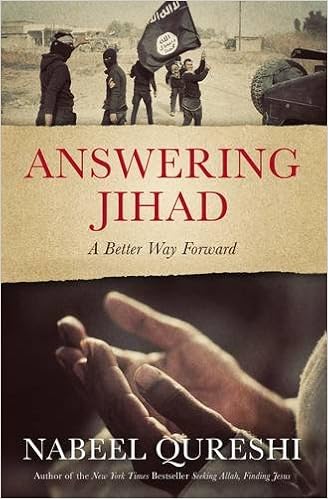 One of the most heated topics among Christians and non-Christians is that of Islam in general and Jihad in particular. The media continually presents stories of violent attacks by Muslim extremists. Terrorist attacks in supposedly safe countries such as Canada, United States, United Kingdom and France are reminders that there are people willing to kill in the name of Islam. At the same time, those who have Muslim friends and colleagues discover them to be kind, generous and loyal to their new country. How should people navigate these conflicting messages?
One of the best books that I have discovered is Answering Jihad: A Better Way Forward written by Nabeel Qureshi. Unlike some who come at Islam out of s spirit of islamophobia spreading a message of fear, Qureshi comes at Islam as a former Muslim who both knows the Qur’an and knows the Muslim community as they really are.
Answering Jihad is organized as a series of short chapters that are answers to relevant questions. This is one of the strengths of this book. I kept hoping that Qureshi would answer a specific question and sure enough, there it is a few chapters later.
One of the big questions that Qureshi tackles is the role of violence in Islam. He concludes that Islam is not a peaceful religion at its core, but rather that the Qur’an and Hadith assume violence as an important aspect of the spread of Islam. In doing so, Qureshi provides a good model for interpreting the Qur’an as well as introducing readers to the less well known Hadith. At the same time, Qureshi reminds us that the average Muslim is not violent and that there many good and kind Muslims in our communities.
Qureshi also discusses the question of whether Christians and Muslims worship the same God. He confesses that in his own conversion, that he had no sense of moving from worship of one God to a different God. However, Qureshi later came to the conclusion that the natures of the Christian and Muslim Gods are significantly different. Instead of spreading the popular argument of “The God of those terrorists is not my God,” Qureshi is able to look at the arguments point by point. His separation of what God is and who God is particularly helpful. Also appreciated is his call for grace for those Christians who disagree on this subject.
Answering Jihad does much more than just answer Jihad. Qureshi provides and a well researched and respectful introduction to Islam. He answers the questions that many readers bring to the subject of Islam.
Stephen J. Bedard


Thanks for this.