




Ethics of Evangelism
What are your thoughts on proselytization? Most people have strong feelings, few just don’t care. Many evangelicals strongly emphasize the sharing of their faith (although they would prefer the term evangelism to proselytization). Some Christians have sincere personal beliefs but do not think that it is fair to share those with others, respecting people’s existing religious beliefs. Some people are deeply offended by any proselytization and would like it banned by law (it already is in some work contexts). Even many evangelicals dread the sight of Mormons or Jehovah’s Witnesses on the doorstep. What do we make of all this?
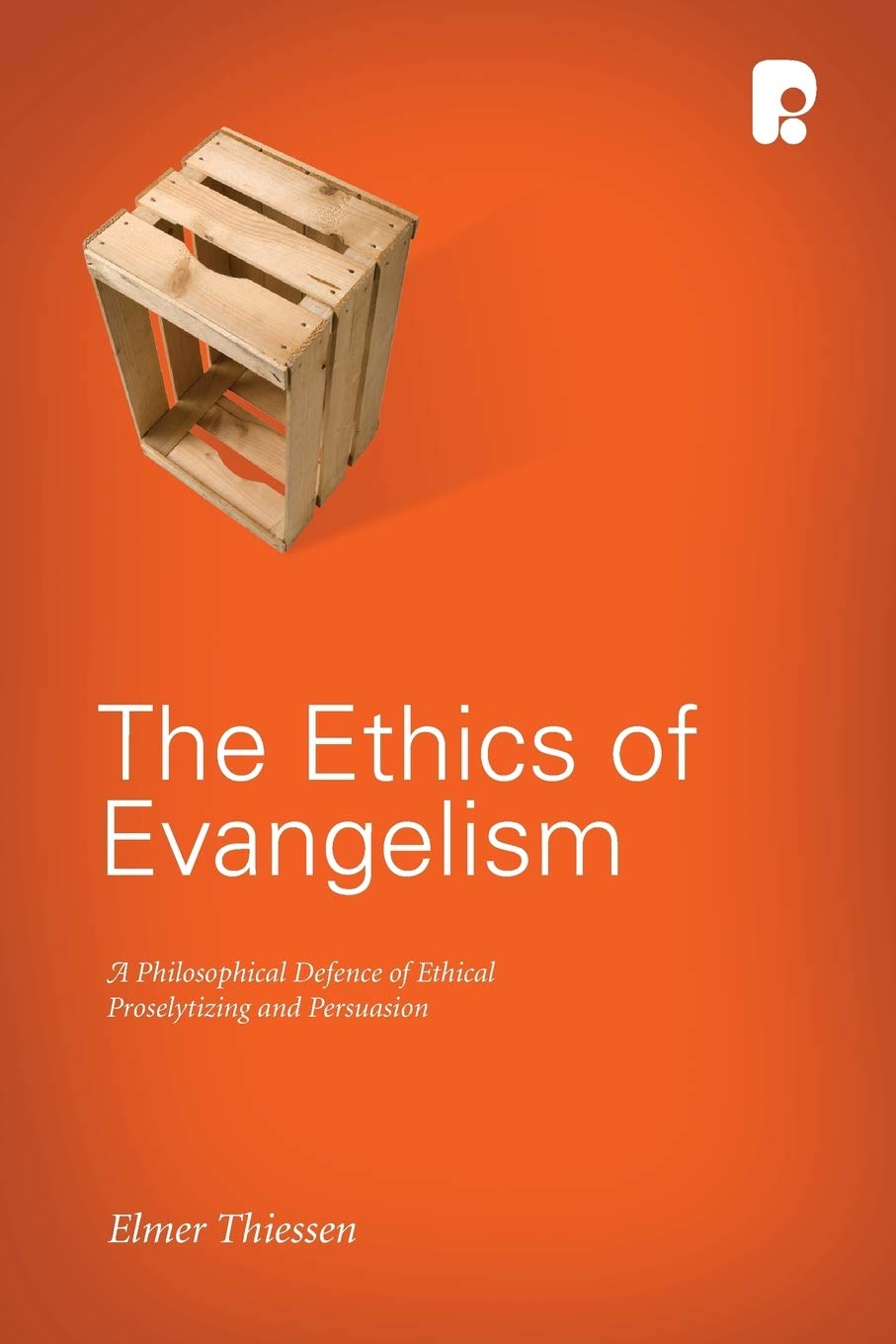 Odds are that although people have strong feelings on the issue, they have not thought deeply on it. Much of what passes for conversation on proselytization is more emotion than anything. That is why I am thankful for Elmer Thiessen’s Ethics of Evangelism: A Philosophical Defence of Ethical Proselytizing and Persuasion. Few have ever considered the ethics of evangelism. Thiessen provides a major contribution to the subject, examining the question of whether proselytizing can ever be ethical. While acknowledging many of the abuses, Thiessen provides a solid philosophical defence. The author demonstrates that proselytizing goes on all the time (e.g. Apple vs PC), and that religious content cannot make it unethical. While the freedom of the person not wanting to be proselytized must be respected, so must the freedom of the religious person to proselytize. Thiessen demonstrates that the presence of proselytization, religious or otherwise, is a benefit to society. At the same time, Thiessen calls Christian to hold firm to ethical standards of evangelism. Even such popular tactics as “friendship evangelism” be unethical if we pretend to be friends just to get a religious conversion. This book is well researched, written in readable style and dealing with an issue important to both religious and non-religious people. I highly recommend this book, especially for people actively involved in evangelistic, apologetic or pastoral ministry.


On a related note, I recently attended a lecture on the tri-faith initiative in Omaha, NE. Essentially, there will be a church, synagogue, and mosque on the same property, with a tri-faith building dedicated to increasing understanding and cooperation. However, all participants have agreed not to proseletyze. The church will be Episcopalian, and the synagogue Reformed, so they’ve selected fairly liberal representatives, but it just strikes me as impossible to align Christian or even Muslim doctrine with such a committment.
Thanks for the book description!
I don’t understand the purpose of agreeing not to proselytize. If you feel strongly about something (religion or anything else), you should tell people. Of course people should to be ethical in their proselytization and should avoid coercion. Thanks for your comments.
I would agree that evangelism ought have its own ethics. I do, however, feel that the Bible lays down an expectation of evangelism. In fact, the whole unfolding and progression of the Bible narrative appears to be a movement from a sonship that is not-by-mutual-consent to a sonship that is by mutual consent. The Israelites were God’s chosen people, but they did not choose God. God chose them. We cannot point to a time in an Israelite’s life when the matured Israelite had a moment of conversion. They were all children of God from the womb. Some say that the Israelites were proselytizing the nations but it appears that God’s forbearance with “the stranger among you” was an accommodation to their race, rather than a way of creating converts. If there were some means whereby Israelites were converting Gentiles to become children of God, there ought to be a doctrine that those Gentiles were obliged to believe. But not even the Israelites became children of God by their embrace of any beliefs. They were children of God by accident of birth. Not so after the life of Christ, however. After His death, burial, and resurrection, a doctrine was set down, and one could become, as an adult, a child of God, by an act of free will, by one’s own consent. This brought something new into the world. Something that had never existed before, and that was the idea of a “marriage” between God and man that was by mutual consent. This had to have been God’s intention from time immemorial – to have a true marriage, a true wife, and not a consort or a concubine or handmaiden (see Gal. 4) who was His only because He took her. I’ve said some things in this vein on a website I maintain, and anyone wishing to delve further can go to this page:
http://jessemullins.com/?p=234 But my point is that the whole Bible’s impetus can be viewed as a progression toward an actual moment of conversion for an adult human being. It was a progression toward free will. And a free will proposition is something to be taken to the nations – something to be carried and disseminated by human efforts, especially if God’s own active demonstrations and disseminations of His ways were something He intended to cease. Which they did, and for a specific reason. That reason was to put an end to revelation and to charge the faithful with carrying His completed truth to the world.
Thanks for the thought-provoking post. I came to this page after seeing a tweet for it. Yes, I’m a follower on Twitter. 🙂 Blessings,
Jesse Mullins
Abilene, Texas
I agree on the biblical mandate to share the Gospel. If Gospel is good news, it is logical that we would want to share it. The author of this book is Christian and agrees with this but writes not just to Christians who accept biblical authority. The section in his book on the ethics is not about imposing unnecessary limitations on evangelism but actually about making evangelism more effective. Non-Christians are not idiots, they know when we are insincere in our methods. Thanks for your thoughts. Glad to connect here and Twitter.