From Shipboard Guards to Pacific Shock Troops: The Origins and Evolution of the United States Marine Corps
The United States Marine Corps is one of the world’s most recognizable military organizations, known for its amphibious warfare capabilities, expeditionary mindset, and fierce esprit de corps. By the end of the Second World War, the Marines had become an elite force renowned for some of the most difficult campaigns in military history. Yet the Corps began as a small body of shipboard soldiers with duties that were quite different from the role it would eventually assume.
The Birth of the Marine Corps
The origins of the United States Marine Corps can be traced to the American Revolution. On November 10, 1775, the Continental Congress authorized the creation of two battalions of Marines to serve with the newly established Continental Navy. The resolution was championed by leaders who recognized the need for troops capable of serving aboard warships and conducting raids against British positions.
The first Marines were recruited at Philadelphia, traditionally associated with the famous Tun Tavern, although the precise role of the tavern in recruiting remains debated by historians. One of the most important figures in the Corps’ early history was Captain Samuel Nicholas, who is often regarded as the first Commandant of the Marine Corps.
The Marines’ original purpose was to provide security aboard naval vessels, enforce discipline among sailors, serve as sharpshooters during naval engagements, and conduct amphibious raids against enemy targets. This close relationship with the navy would remain a defining characteristic throughout the Corps’ history.
Marines and the Navy
From its inception, the Marine Corps was tied to naval operations. Marines were not sailors, but they served aboard ships and operated under naval command structures. Their unique role placed them somewhere between a naval and land force.
During the Age of Sail, Marines protected ship officers from mutinous crews, guarded prisoners, and fired from elevated positions during combat. They also formed landing parties that could seize ports, conduct raids, and attack enemy installations.
This relationship continues today. The Marine Corps remains a separate military service within the Department of the Navy. Marines often deploy aboard naval vessels and rely heavily upon naval transportation, logistics, and fire support.
The Early Republic and Survival of the Corps
Following the American Revolution, both the Continental Navy and Marines were disbanded. However, growing international tensions led Congress to re-establish the Marine Corps on July 11, 1798.
The new Corps saw action during the Quasi-War with France and later in the Barbary Wars against the North African states that preyed upon American shipping. One of the most famous episodes occurred during the First Barbary War when Marines participated in the capture of Derna in present-day Libya in 1805. This campaign is commemorated in the Marine Corps Hymn’s reference to the “shores of Tripoli.”
Throughout the nineteenth century, Marines continued to serve as naval infantry and participated in numerous overseas expeditions.
Marines and the Army
The relationship between the Marine Corps and the United States Army has often been complex. Both services are land-fighting organizations, leading to periodic debates over their respective roles.
Historically, the Army focused on large-scale land campaigns and continental defense, while the Marines specialized in naval expeditions, shipboard service, and rapid-response operations. Although Marines occasionally fought alongside Army units, they generally emphasized smaller expeditionary missions.
At various times, proposals were made to absorb the Marines into the Army. The Corps survived these challenges by demonstrating its unique value as a force capable of quickly deploying from the sea and conducting amphibious operations.
The Nineteenth Century and Overseas Expansion
Throughout the nineteenth century, Marines participated in numerous interventions around the globe.
They fought in the Mexican-American War (1846–1848), including actions during the campaign against Mexico City. Marines also participated in operations in China, Japan, Korea, and throughout the Caribbean.
By the late nineteenth century, American expansion overseas increased demand for expeditionary forces. Marines took part in the Spanish-American War of 1898, including the seizure of Guantánamo Bay in Cuba.
The war marked America’s emergence as a global power and expanded the Marines’ role in overseas operations.
The “Banana Wars”
Between roughly 1898 and 1934, Marines were heavily involved in a series of interventions throughout the Caribbean and Central America. Historians often refer to these operations as the “Banana Wars.”
Marine units served in:
- Haiti
- Nicaragua
- Cuba
- Honduras
- Panama
- the Dominican Republic
These campaigns involved counterinsurgency, occupation duties, and nation-building efforts. Officers such as Smedley Butler gained valuable experience during these conflicts.
Lessons learned during the Banana Wars shaped Marine doctrine concerning small-unit tactics, leadership, and expeditionary warfare.
Developing Amphibious Warfare Doctrine
During the 1920s and 1930s, Marine leaders began preparing for a potential conflict in the Pacific.
Strategists recognized that any war against Japan would require American forces to seize heavily defended islands across vast ocean distances. The Marine Corps became the principal laboratory for amphibious warfare doctrine.
Key figures included:
- John A. Lejeune
- Earl Hancock Ellis
- Holland Smith
Ellis, in particular, anticipated many of the challenges of a future Pacific war. His studies emphasized the need to seize island bases through coordinated naval, air, and ground operations.
The Marines conducted extensive exercises with the Navy and developed specialized landing techniques, equipment, and organizational structures. By 1941 they possessed the world’s most advanced amphibious warfare doctrine.
The Marine Corps in the Second World War
When Japan attacked the naval base at Pearl Harbor on December 7, 1941, the Marine Corps numbered approximately 66,000 personnel. By the end of the war, it had expanded to nearly 500,000 Marines.
Early Defensive Battles
Marines participated in several desperate defensive actions during the opening months of the war.
At Wake Island, Marines resisted Japanese attacks for two weeks before being overwhelmed. Marines also formed part of the garrison defending the Philippines.
These actions helped establish the Corps’ wartime reputation for tenacity.
Guadalcanal: The Turning Point
In August 1942, the Marines launched the first major American offensive of the war by landing on Guadalcanal.
The six-month campaign became one of the most significant battles of the Pacific War. Marines endured intense combat, disease, shortages, and repeated Japanese counterattacks.
The victory marked a turning point in the Pacific and demonstrated the effectiveness of amphibious operations supported by naval and air power.
Island-Hopping Across the Pacific
The Marine Corps became the spearhead of the Allied advance through the Central Pacific.
Major Marine operations included:
- Tarawa Atoll (1943)
- Saipan (1944)
- Tinian (1944)
- Peleliu (1944)
- Iwo Jima (1945)
- Okinawa (1945)
Each campaign demonstrated increasing sophistication in amphibious assault techniques. Marines coordinated closely with naval gunfire, carrier aviation, and logistical support systems.
Iwo Jima and the Marine Legend
The battle for Iwo Jima became one of the most famous Marine operations in history.
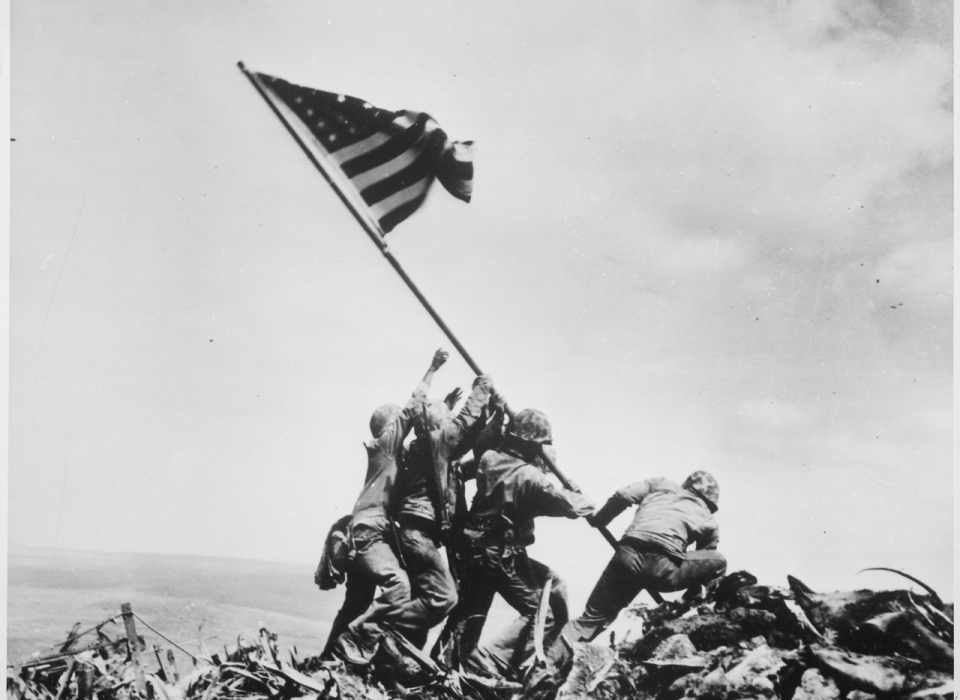
The iconic photograph taken by Joe Rosenthal showing Marines raising the American flag atop Mount Suribachi became one of the defining images of the war.
The battle cost nearly 7,000 Marine dead and demonstrated the extraordinary difficulty of assaulting fortified Japanese positions.
Okinawa
The final major Marine campaign of the war occurred on Okinawa. Marines fought alongside Army units in one of the largest amphibious operations ever conducted.
The battle provided a grim preview of what an invasion of Japan might entail. The enormous casualties suffered by both sides contributed to American decisions regarding the use of atomic weapons and the pursuit of Japan’s surrender.
Evolution of the Marine Corps
Between 1775 and 1945, the Marine Corps underwent a remarkable transformation.
It evolved from:
- Shipboard guards serving aboard sailing vessels
- Naval infantry conducting small raids
- Expeditionary troops in overseas interventions
- Counterinsurgency specialists during the Banana Wars
- Amphibious assault experts during the Second World War
The Corps also developed a distinct identity emphasizing discipline, aggressive leadership, and adaptability.
By the end of the Second World War, the Marines had proven that they were far more than soldiers who happened to serve aboard ships. They had become the world’s foremost amphibious assault force and a central component of American military power.
Conclusion
The United States Marine Corps was born during the American Revolution to serve alongside the navy, but its history became one of continual adaptation. Through service in naval battles, overseas interventions, counterinsurgency campaigns, and finally the brutal island battles of the Pacific, the Marines forged a unique role between the Army and Navy. By 1945, the Corps had emerged as an elite expeditionary force whose doctrine, organization, and battlefield experience would shape military operations for decades to come. The victories at Guadalcanal, Tarawa, Iwo Jima, and Okinawa cemented the Marine Corps’ place in American history and established the legacy that continues to define the service today.