The Lost World of Scripture – Review
 The inerrancy of Scripture is one of the most controversial doctrines among Evangelicals. How one responds to inerrancy often determines whether one is employed at certain seminaries or a member in certain scholarly societies.
But what does inerrancy mean and at what point was Scripture inspired?
Even the strongest on errancy will admit that errors have crept in during the copying of the manuscripts. That is why it is normally the autographs that are considered inerrant. But what if things are even more complicated?
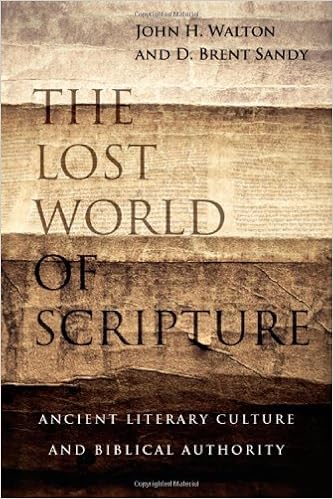
John H. Walton and D. Brent Sandy tackle these issues in The Lost World of Scripture: Ancient Literary Culture and Biblical Authority.
According to the authors, questions of inspiration and inerrancy cannot begin with our modern take on the Bible. Our starting point must be the ancient literary culture.
How does this affect the question of inspiration and inerrancy? Considering most ancient texts began in an oral form and there is evidence within the Bible for these same characteristics, where did the inspiration take place? Was it inspired as an oral tradition and then written or was it an oral tradition that was later inspired in its written form? Perhaps both?
The authors also deal with the standards of precision in the ancient world. What would be required for something to be an error in the Bible? Would the Bible have to meet modern standards or should it be held to ancient standards?
Throughout the book, the authors affirm inerrancy. But what they mean by inerrancy may be different from what others affirm. By inerrancy, they agree with David Dockery with this definition:
[The] Bible properly interpreted in light of [the] culture and communication developed by the time of its composition will be shown to be completely true (and therefore not false) in all that it affirms, to the degree of precision intended by the author, in all matters relating to God and his creation. (p. 12)
I think that is a pretty good definition of inerrancy and one that I can affirm.
I suspect that many Evangelicals would be somewhat uncomfortable with some of the conclusions of the authors. There were some statements that I was not sure about. At the same time, I believe that this is an important book for Evangelicals to read. While it may not have the final answer on the issue of inerrancy, it is tremendously valuable at shaping the questions that we need to be asking.
I highly recommend The Lost World of Scripture for those who are interested in questions about the nature of the Bible and its authority.