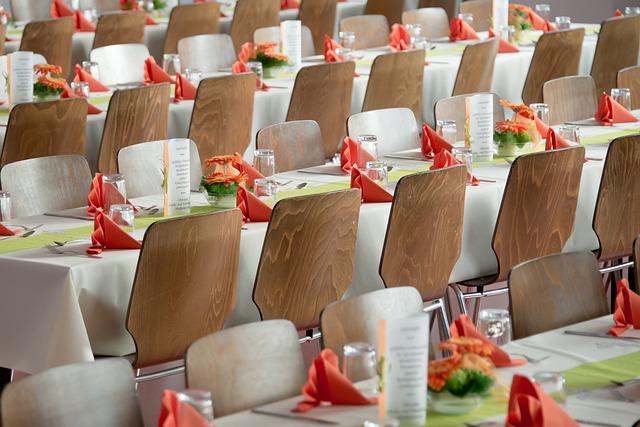
Preparing For the Banquet
This is the talk that I gave at the recent Banquet of Belonging conference put on by A Deeper Communion. I was great to catch up with come of my colleagues in the disability theology and ministry world.
Imagine you are visiting a certain landmark near your home. You happen to notice a group of about twelve tourists from another country who are trying to figure things out in a culture and language that they are not familiar with. Since you want to make sure that their visit is pleasant one, you decide that you want to invite them to your place, in the words of this event, to a banquet of belonging. What would it take in terms of circumstances for you to move from first seeing the group to approaching them with an actual invitation to eat a meal at your home? While we might think that this should just be an automatic jump, there are things to consider. What kind of home do you have and will it fit everyone? If there is anyone with accessibility needs, will they be able to get into your home? Do you have enough places to sit? Do you live alone, and if not, how would the people you live with feel about your sudden invitation? Do you have enough food to feed everyone and if not, do you have a plan on how to provide the food? These are not excuses not to invite them, but they are things that you should consider before the invitations go out.
During my time as a pastor and once that it was made known that I was interested in disabilities and the church, I began to receive messages from people. The details were different but the general message was “Help! We have someone with a disability who has started attending our church and we don’t know what to do!” What I want to say is that they should have been asking questions before the person first showed up but what I do is share what I know.
I love the idea of welcoming disabled people as bringing them into a banquet of belonging. But just as there is work to be done before welcoming people to a literal banquet, we also need to do certain things before the banquet of belonging. Having said, we better not turn away anyone just because we are not quite ready. A microwaved can of ravioli is better than nothing.
I also want to say that the preparation that I am speaking of is not a formal disability ministry. I have been in churches where they get one teenager and they feel obligated to start a youth ministry. The same thing happens when a disabled person arrives. There are certain things that we can do long before that next person with a disability shows up.
The first thing we need to do in preparation is to check our theology. What do I mean by that? How does your theology include disabled people? Are they something broken that needs to be fixed? Are they signs of a lack of faith? Are they a part of natural diversity that should be celebrated? How you welcome someone is going to be shaped by your theology. You might not have an official doctrine of disabilities but you can begin to explore what the Bible says. You can talk to disabled Christians and hear their experiences.
The second thing you need to do is reflect on the purpose of your worship. Why is that? The area that I am most personally touched by is autism. Because of this, one of the most frequently asked questions I receive is, what should they do if an autistic person starts making a loud noise. What is the best way to remove the person with the least amount of fuss? While I understand the question, it says something about the purpose of worship. When your church gathers to worship, what is it that you hope will be achieved? We do not normally explicitly ask this question but it is important. Many churches see worship gatherings as an attraction to bring in new people. The hope is that visitors will come and be impressed with the excellence of the music and the preaching and will decide to make this their church home. Pastors pray that the sound board does not go haywire, that there are no other technology glitches, and that in general nothing happens that will turn people off. If that is the case, what is the reaction to an autistic person starts to exclaim some random line from a movie in a loud voice? There are other ways to look at worship. I am ashamed to say that I went through much of my life without realizing a basic fact: worship is for God’s sake. I looked carefully at the Bible and I could not find any indication that worship was meant to provide pleasure for the participants. The common phrase, “I just didn’t enjoy worship this morning” has no biblical support. If this is the case, is there anything that a disabled person could do to interfere with God receiving worship? The only way that God might get disturbed in such a situation is if people react with judgmental and mean-spirited response to the disabled person.
Please notice that so far, there has been no requirement for an increase in budget and nothing so far even requires a person with a visible disability to be attending the church. What has been said is valuable no matter how big the church or who is attending the church. However, these steps are essential for truly welcoming and embracing disabled people. These are not steps that can be skipped.
Now we can consider physical accessibility. Most likely, your building has a lift or a ramp but that is not necessarily enough. Have a person in a wheelchair to take a tour of your building and see how things are in reality. Are there areas that are regularly used for ministry that are not accessible? What about sensory issues? What is your policy on scents? Do you use lights for special effects? Are there any issues with the sound system? How much does a service rely on people being able to see images or words on the screen? There are ways for you to test these things out beforehand, addressing obstacles before that family addresses your church.
Having done all of that, it is important for you to do one more thing. While it is a big step for any new family to visit a new church, there is an added dynamic for families who experience disabilities, whether physical or developmental. This is what you need to know: It is always easier to stay home than to go to church. This is why you need to know it: every bad experience will me magnified but also every good experience will be magnified.
Staying on the theme of a banquet, it is good to have in your mind one good recipe, something that can work on any occasion. And so I want to get you read with an all-purpose recipe, good for any banquet. What disabled people really want in church, and this is true for all people, is relationships. Now what those relationships look like is going vary from person to person. For myself, I would feel very overwhelmed if everyone approached me want to be my best friend.
You might think that having a disability does not make things that harder if the building is accessible. At one of my churches, for the last three years that I was there, my wife rarely attended because she stayed home with our autistic children. When I was done at that church, I took a break from pastoral ministry and my wife started attending church and I stayed home with our children. There were times we all went, but I always felt the emotional barrier of all that was required for us to get there and to anticipate any negative reactions. I did the research for my DMin thesis during covid and I was amazed at how many disabled people were breathing a sigh of relief during the lockdown when services were online. This was actually a benefit for many people. There is a price to be paid, sometimes physically and sometimes emotionally, for disabled people to come to church. Reflect deeply on this before that family arrives. Not so that you can make sure everything is perfect, because it will not be, but so you can empathize with them and can be prepared to respond in appropriate ways. A huge part of that should be listening to what they need instead of anticipating what you think they might need. You can prepare for this ahead of time by cultivating a posture of listening and learning. There is no way you can become a subject matter expert in every disability that is out there but you can develop your listening skills as well as your curiosity.
What I have shared is not the full banquet. It is the purchase of the table and chairs. It is the selection of a few items for the menu. It is some basic groceries that will enable you to have those people over for a pleasant meal. The measurement is not perfection, although we strive to improve. If we waited for perfection for a literal banquet, we would never have anyone over. If we waited for perfection to welcome and include disabled people, we would never be ready. The wonderful things is that most of the preparation that I have shared is not something that has a financial cost. There is a cost, just not to our bank accounts. It may make us change our thinking on certain topics, but that is a good thing.