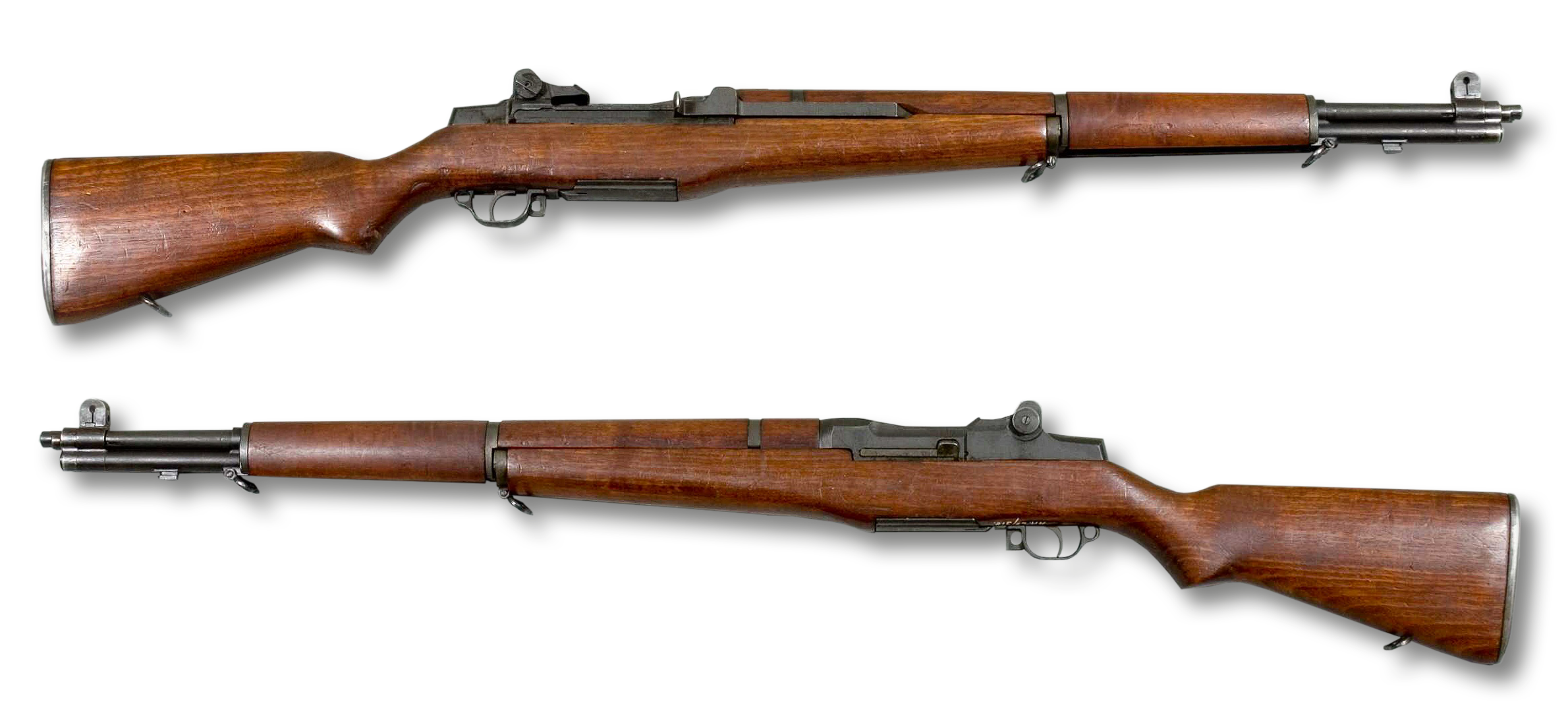
Rifles of the U.S. Military During World War II
World War II marked a turning point in military firearms technology. The United States entered the war with a mixture of older bolt-action rifles, newer semi-automatic weapons, and specialized firearms designed for paratroopers, snipers, and support troops. By the end of the conflict, the U.S. military had helped revolutionize infantry combat through widespread use of semi-automatic rifles and improved battlefield firepower.
The rifles used by American forces reflected changing military doctrine, industrial capability, and the realities of modern warfare. Some became legendary for reliability and effectiveness, while others revealed the limitations of rapidly evolving technology.
The M1 Garand: America’s Standard Battle Rifle
The most famous American rifle of World War II was the M1 Garand. Designed by Canadian-American engineer John Garand, the rifle became the standard U.S. service rifle in 1936 and remained in use through the Korean War.
General George S. Patton famously called it “the greatest battle implement ever devised.”
Why the M1 Garand Was Used
Before World War II, most major armies still relied on bolt-action rifles. The M1 Garand was revolutionary because it was semi-automatic. Every pull of the trigger fired a round and automatically loaded the next cartridge without manually operating a bolt.
This gave American infantry a major advantage in firepower and rate of fire.
The rifle fired the powerful .30-06 Springfield cartridge and used an eight-round en bloc clip.
Technological Advances
The M1 represented a major technological leap:
- Semi-automatic gas-operated system
- Faster firing capability than bolt-action rifles
- Reduced need to manually cycle the action
- Better suppressive fire capability for infantry squads
In combat, an American soldier with an M1 could fire far more rapidly than enemy troops armed with bolt-action rifles like the German Karabiner 98k or Japanese Arisaka.
Effectiveness
The M1 proved highly effective in nearly every theater of the war:
- Accurate at medium and long ranges
- Durable in difficult conditions
- Reliable in mud, cold, and jungle environments
- Excellent stopping power
American troops appreciated the rifle’s firepower during assaults and defensive engagements alike.
Problems and Criticisms
Despite its reputation, the M1 had some drawbacks:
- Heavier than many bolt-action rifles
- The eight-round clip could not easily be topped off
- The distinctive “ping” sound made when the clip ejected became legendary, though stories about enemies exploiting the sound are likely exaggerated
The rifle also required more manufacturing complexity than older bolt-action designs.
The M1903 Springfield
Although overshadowed by the Garand, the M1903 Springfield remained an important rifle during World War II.
Originally adopted in 1903, it was a bolt-action rifle heavily influenced by the German Mauser system.
Why It Continued to Be Used
At the start of the war, the United States did not have enough M1 Garands for all troops. Large numbers of Springfields remained in storage and were issued to:
- Training units
- Reserve formations
- Marines early in the Pacific War
- Snipers
The rifle’s exceptional accuracy also made it ideal for sniper conversions.
Technological Characteristics
The M1903 used:
- Bolt-action operation
- Five-round internal magazine
- .30-06 Springfield ammunition
Compared to the Garand, it was mechanically simpler but slower to fire.
Effectiveness
The Springfield was highly respected for:
- Long-range accuracy
- Reliability
- Strong construction
Snipers particularly valued it, especially the M1903A4 sniper variant equipped with telescopic sights.
Problems
The main weakness was rate of fire. Against enemies armed with semi-automatic or automatic weapons, bolt-action rifles increasingly appeared outdated.
Still, many experienced marksmen considered the Springfield one of the finest military bolt-action rifles ever made.
The M1 Carbine
The M1 Carbine was developed to provide a lighter weapon for troops who were not front-line infantry.
It was intended for:
- Officers
- Paratroopers
- Radio operators
- Vehicle crews
- Support personnel
Why It Was Adopted
Many soldiers found pistols ineffective in combat, while full-sized rifles were heavy and cumbersome for support troops.
The M1 Carbine filled the gap between pistol and rifle.
Technological Features
The carbine featured:
- Semi-automatic action
- Detachable magazine
- Lightweight design
- Smaller .30 Carbine cartridge
At roughly five pounds, it was far lighter than the Garand.
Effectiveness
Troops appreciated the M1 Carbine because it was:
- Easy to carry
- Compact
- Quick to fire
- Effective at short and medium ranges
Paratroopers especially favored folding-stock variants during airborne operations.
Problems
The smaller cartridge lacked the power of the Garand’s .30-06 round. Complaints included:
- Limited stopping power
- Reduced effectiveness at long range
- Poor penetration through heavy cover
In the Pacific Theater, some soldiers believed the carbine was less effective against determined Japanese troops.
Even so, the M1 Carbine became one of the most widely produced American firearms of the war.
The Johnson Rifle
The Johnson M1941 rifle was a competitor to the M1 Garand designed by Melvin Johnson.
Although never officially adopted as the primary U.S. service rifle, it saw limited use by some Marine and special operations units.
Technological Innovations
The Johnson rifle included several advanced features:
- Short recoil operation
- Ten-round rotary magazine
- Ability to reload without emptying the magazine
- Quick-change barrel
Some Marines appreciated these features during combat in the Pacific.
Effectiveness and Problems
The Johnson rifle was accurate and innovative, but it had weaknesses:
- More mechanically delicate than the Garand
- Sensitive to dirt and rough handling
- Bayonet use could interfere with operation
Ultimately, the M1 Garand proved more rugged and practical for mass military use.
Sniper Rifles
The U.S. military also fielded sniper variants during the war.
M1903A4 Springfield
The primary American sniper rifle was the M1903A4:
- Bolt-action
- Equipped with a telescopic sight
- Extremely accurate
It was widely used in Europe and the Pacific.
M1C and M1D Garand Snipers
Toward the end of the war, scoped versions of the Garand appeared:
- Semi-automatic sniper capability
- Faster follow-up shots
However, these rifles arrived too late to replace the Springfield in large numbers during World War II.
The Marine Corps and Rifle Preferences
The U.S. Marine Corps initially relied more heavily on the M1903 Springfield during the early Pacific campaigns.
Many Marines respected the Springfield’s accuracy, especially in jungle fighting where long-range marksmanship remained important.
As production increased, the Marines gradually transitioned to the M1 Garand. By the later years of the war, most Marine units used the Garand extensively.
American Firepower Compared to Other Nations
One of the greatest advantages enjoyed by American infantry was widespread use of semi-automatic rifles.
Most German and Japanese soldiers still carried bolt-action rifles:
- German Karabiner 98k
- Japanese Arisaka Type 38 and Type 99
This meant American infantry squads often produced greater sustained firepower during engagements.
The Soviet Union also increasingly used semi-automatic and automatic weapons, but no major army issued a semi-automatic rifle as universally as the United States did with the M1 Garand.
Manufacturing and Industrial Power
American industrial capacity played a major role in rifle production.
Millions of rifles were produced during the war:
- Over 5 million M1 Garands
- More than 6 million M1 Carbines
- Large numbers of Springfield rifles and variants
Companies such as Springfield Armory, Winchester, Inland Manufacturing, and IBM contributed to wartime firearm production.
This enormous manufacturing effort ensured that American troops remained well-equipped throughout the conflict.
Lasting Legacy
The rifles of World War II helped shape modern infantry doctrine.
The success of the M1 Garand demonstrated the superiority of semi-automatic service rifles over bolt-action weapons. After the war, nations around the world increasingly adopted semi-automatic and eventually fully automatic infantry rifles.
The M1 Carbine influenced later lightweight assault weapon concepts, while sniper developments foreshadowed modern precision rifles.
Many of these firearms remained in service long after World War II:
- The Garand served extensively in Korea
- Carbines remained in use into Vietnam
- Springfield sniper rifles continued influencing later designs
Today, these rifles remain iconic symbols of the American soldier during World War II.
Conclusion
The rifles used by the U.S. military during World War II reflected a period of rapid technological change and industrial innovation. The M1 Garand gave American infantry unprecedented firepower, while the Springfield remained a trusted precision weapon. The M1 Carbine provided mobility and convenience for support troops, and experimental designs like the Johnson rifle hinted at the future of infantry firearms.
Each rifle had strengths and weaknesses, but together they helped give American forces a critical battlefield advantage. More than just weapons, they represented the transformation of modern warfare from the age of bolt-action rifles to the era of high-volume infantry firepower.