
The Cost of Faith
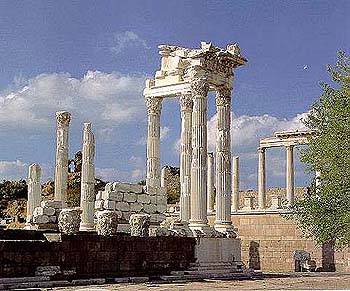 “To the angel of the church in Pergamum write:
These are the words of him who has the sharp, double-edged sword.I know where you live—where Satan has his throne. Yet you remain true to my name. You did not renounce your faith in me, even in the days of Antipas, my faithful witness, who was put to death in your city—where Satan lives.
Nevertheless, I have a few things against you: You have people there who hold to the teaching of Balaam, who taught Balak to entice the Israelites to sin by eating food sacrificed to idols and by committing sexual immorality.Likewise you also have those who hold to the teaching of the Nicolaitans.Repent therefore! Otherwise, I will soon come to you and will fight against them with the sword of my mouth.
He who has an ear, let him hear what the Spirit says to the churches. To him who overcomes, I will give some of the hidden manna. I will also give him a white stone with a new name written on it, known only to him who receives it.”
(Revelation 2:12–17 NIV)
Introduction
They say that you get what you pay for. For the most part that is true. I am what I call frugal, or others might call cheap. If I can save some money, I am very interested. There are somethings that do not matter as the quality difference is very slim. But there are other things, that if you took into account how many times you had to replace it, you would find that you could have bought a better quality and longer lasting product for less. If that is true for cars, appliances, electronics and other items, how much truer is it for faith? I want you to imagine that I decided to start a new religion. God wants to give you everything. He is willing to give you an eternity in heaven. He will heal every disease and make you extremely rich. In addition, he has no interest in how you live your life. He does not want worship, prayer or church. He does not care if you are nice person or if you obey the laws of the land. All God wants is for you to lift your right hand and give a thumbs up to the sky and all of this is yours. That would be a pretty cheap religion. Perhaps at first glance there might be something attractive to it. But remember, you get what you pay for. If all you have to do is give the thumbs up, perhaps God will give just as much effort in helping us. Here is where things get complicated for Christians. We do not believe that one can earn God’s love or earn salvation. We believe that Jesus purchased our forgiveness and salvation on the cross. We are saved simply by putting our faith in Christ. This is the grace of God. That is a wonderful truth, that we are saved by grace and not by being good enough, because we could never be good enough. But there is grace and there is what Dietrich Bonhoeffer called cheap grace. What is cheap grace? Cheap grace is the attitude of “Yeah, yeah, Jesus is the way. Now give me my ticket to heaven.” Cheap grace is not real grace. Real grace is an awareness that it was not cheap for God to bring us to him, it cost him his very Son. When we are aware of the nature of true grace, it compels us to want to put our faith into action. Let us look what this looked like for the Christians at Pergamum.
Pergamum
First of all, notice that Jesus addresses himself as the one who has the two edged sword. Later on in the letter, we are told that the sword comes from his mouth and we understand this to be the words of Jesus. The point of a two edged sword is that it can cut two ways. In the same way, there are two costs for the Christian. The first is in conflict with those outside the church. I want you to think about any time you have felt put down or mocked for being a believer in Jesus. How would you describe that place? Now listen to where the Christians at Pergamum live. They live where Satan’s throne is. That just cannot be good. We do not know why that specific reference was made. Was it because of one of the Greek or Roman gods? Was it because of the emperor worship? We just do not know and frankly we do not need to know. What we do know is that this was not an easy place for Christians to live. The name Satan is really a title which means accuser. By calling this place Satan’s throne, we see that this was not a place that hate occasional satanic oppression. Satan was so comfortable at Pergamum that he had his own chair. We are not to imagine a horned red individual with a pitchfork roaming the streets of Pergamum. What we are to imagine is the real persecution that was taking place. We are told that it even came down to death for some people. When you think of the word martyr, what is the first thing you think of? Probably someone dying for their faith. What is interesting is that before Christianity, that word had nothing to do with death or violence. The word simply meant witness. However, for Christians early on, to witness for Jesus meant to put their life on the line. Jesus praises the Christians at Pergamum for holding to their faith. The second part was not so good. The church has some among them that have false teachings. We are not talking about the normal variation in doctrine as we might have in our congregation with people from various backgrounds. We are talking about beliefs in terms of worship and ethics that would naturally lead people right away from God. For whatever reason, the church was tolerating this. Perhaps it was because it is easier to stand against people outside with whom you have no relationship than it is with people in your own church. But that is part of the cost of faith. As much as we must stand firm against external attacks, we must also have strong stands to the theological standards of the church.
Our Cost
What is the cost that we experience for being a Christian? We take some time to attend church services and we put some money in the offering plate. Is that all? The same principles that affected the Christians at Pergamum affect us. One cost is that we must stand up to a culture that opposes our faith. We may not think of ourselves living where Satan’s throne is but there is a culture that is hostile to Christianity. You may not have experienced this yet. That is because as a church we have worked hard to fit in, be respectable and to adapt to the culture around us. But the minute we are truly honest about our faith: that there is a God, that Jesus is the Son of God, that Jesus is the only way to receive eternal life and that there will be a final judgment, that cannot help but cause some conflict. Jesus said that he was coming with a sword, not that of warfare but a division between those who believe and those who do not. The Christian worldview and the non-Christian worldview are naturally going to come into conflict. We need to choose whether we stand or compromise. We also will have a cost within the church. We love each other and support one another. But if one of us, including myself, began preaching a theology that was leading us away from devotion to Christ or a moral lifestyle, we would have to take a stand. We are not interested in a doctrine police but we are interested in helping each other stay on the straight and narrow. Let me give you an example. I mentioned the phrase cheap grace made famous by Dietrich Bonhoeffer. Dietrich Bonhoeffer was a German theologian and pastor. While greatly respected today, he was unpopular with many of his contemporaries. You see Bonhoeffer was active during the years of the Nazi control of Germany. Very early on, the Nazis understood the importance of controlling the churches. Unfortunately, there were many pastors who were more than willing to preach the Nazi message, although they likely did not fully understand what the Nazis were doing. Dietrich openly challenged those church leaders who were collaborating with the Nazis. Dietrich was always challenging the church to live according to the Scriptures and there were many that did not like it. Bonhoeffer also allowed his faith to confront the evils of culture. Early on he saw the persecution of the Jews and other evil actions. He saw the Christian faith as not being a small isolated part of life but he wanted biblical values to influence the world. This was not an easy thing to do and our practice of sending a polite petition to our government is no comparison. Things got so bad that Bonhoeffer eventually became involved in a plot to assassinate Adolph Hitler. This was costly in a number of ways. First of all, Bonhoeffer did not believe in violence and so being involved in a such a thing says much about how bad things were. However, Bonhoeffer’s involvement in this failed plot eventually led to his arrest and imprisonment in a concentration camp. He ended up executed by the Nazis as the allied troops were approaching to liberate the camp. His last known words were “This is the end — for me the beginning of life.”
Conclusion
What is the cost of faith? In one way salvation is the free gift of grace. In another way, it should be the most costly decision we ever make. To put our faith in Jesus is to make him our Lord. That means we must follow Jesus. There will be a cost if we are honest about our faith in terms of how people outside the church will react. There will be a cost even within the church as we stand for what we know to be right. Hopefully we will not pay with our lives as Dietrich Bonhoeffer did, but it will cost. Whenever we question whether it is worth it, think of what it cost God in allowing his Son to die on the cross. And then remember, you get what you paid for.