The Gospel in the Marketplace of Ideas
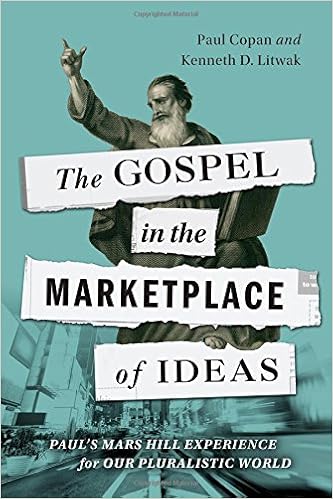
Paul Copan and Kenneth D. Litwak, The Gospel in the Marketplace of Ideas: Paul’s Mars Hill Experience for Our Pluralistic World (Downers Grove: InterVarsity, 2014), Pbk. 176 pp.
 One of the common passages for apologists to go to for a model of apologetic conversation is Paul’s experience at Athens in Acts 17. Such a choice is not without controversy as some look to Paul’s strategy in Athens as a failure and something to be avoided. Even a highly respected evangelical New Testament scholar such as F.F. Bruce understood this passage as being presented in a critical light.
In The Gospel in the Market Place of Ideas, Paul Copan and Kenneth Litwak, take a detailed look at Acts 17, both in its original context and for its value in today’s world. Paul Copan comes as a philosopher with an apologetics focus and Kenneth Litwak as a New Testament scholar who is able to place the passage in its original setting.
Copan and Litwak offer a convincing argument that Luke never intended to be critical of Paul’s methodology in Athens. They demonstrate that the evangelistic results he saw, were no different than what was found in other cities as described in Acts. They also show that the negative interpretation of Paul’s methodology and supposed regret toward it, is based on a misunderstanding of Paul’s criticism of philosophy in 1 Corinthians.
The majority of the book is spent going through the Acts 17 passage in detail. A tremendous amount of background information is given on each section of the passage. Particularly helpful is the explanation of the relevant philosophical schools and Greco-Roman religions. The authors are able to provide a good amount of solid New Testament background but in a way that a reader without the technical background can understand.
The purpose of the book is not just to be a commentary on a New Testament passage. It is written to help bridge the gap between the Athens of two thousand years ago and the modern world. The authors demonstrate that many of the same dynamics from Paul’s day are just as active today. The principles found in Acts can be used effectively in communicating the Gospel in a modern ministry context. The authors work through these principles and challenge the Church to interact with our pluralistic world in thought thoughtful and biblical ways.
The Gospel in the Marketplace of Ideas is an excellent resource that would be useful in any teaching on apologetics or evangelism
Stephen J. Bedard