
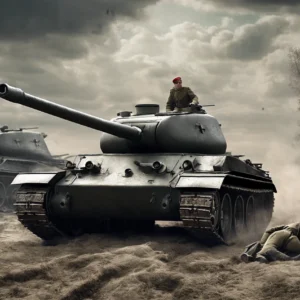
The Tanks of the Soviet Union During the Second World War

The Soviet Union’s armored forces were a crucial element in the defeat of Nazi Germany during the Second World War. From the vast plains of Russia to the streets of Berlin, Soviet tanks played a decisive role in the brutal combat that characterized the Eastern Front. Over the course of the war, the Red Army deployed a diverse array of tanks, evolving their designs in response to the shifting tides of battle and the need to counter advanced German weaponry. In this post, we’ll explore the major types of Soviet tanks that defined their armored force during the war.
1. Light Tanks
Light tanks were an essential component of the Soviet armored forces in the early stages of the war. Designed primarily for reconnaissance and support roles, these tanks were fast, lightly armored, and equipped with relatively small-caliber weapons.
- T-26: The T-26, derived from the British Vickers 6-Ton tank, was the backbone of the Soviet tank fleet at the start of the war. While its 45mm gun was sufficient in the 1930s, it proved woefully inadequate against modern German armor during Operation Barbarossa.
- BT Series: The BT (Bystrokhodny Tank or “Fast Tank”) series emphasized speed and mobility, with the BT-7 being the most advanced model. Despite their high speed and maneuverability, their thin armor made them vulnerable in combat.
By 1941, light tanks like the T-26 and BT series were largely obsolete, and their limitations contributed to heavy Soviet losses in the early phases of the war.
2. Medium Tanks
Medium tanks were the workhorses of the Soviet armored forces, balancing firepower, mobility, and protection.
- T-34: Widely regarded as one of the most important tanks of the war, the T-34 revolutionized tank warfare with its sloped armor, powerful 76.2mm gun, and excellent mobility. Introduced in 1940, the T-34 dominated the battlefield in the early years of the war, forcing Germany to develop heavier tanks like the Panther and Tiger.
- T-34/85: In 1943, the T-34/85 variant was introduced with an upgraded 85mm gun, allowing it to effectively engage the heavier German tanks. This version remained in service well into the Cold War and cemented the T-34’s legacy as a symbol of Soviet engineering.
The T-34 series proved to be a game-changer, combining simplicity of production with battlefield effectiveness.
3. Heavy Tanks
Heavy tanks were designed to break through fortified enemy positions and engage the heaviest German armor.
- KV Series: The KV (Kliment Voroshilov) series was the Soviet Union’s main heavy tank in the early war years. The KV-1, with its thick armor and 76.2mm gun, was virtually impervious to most German anti-tank weapons during the early stages of the war. However, its slow speed and mechanical reliability issues limited its effectiveness.
- IS Series: In 1943, the KV series was replaced by the IS (Iosif Stalin) series of heavy tanks. The IS-2, armed with a massive 122mm gun, was a formidable weapon against both German tanks and fortified positions. Its heavy armor and firepower made it a key player in the final Soviet offensives of the war.
Heavy tanks like the KV and IS series were instrumental in tipping the scales in favor of the Soviet Union during critical battles.
4. Self-Propelled Guns and Tank Destroyers
To complement their tanks, the Soviets developed a range of self-propelled guns and tank destroyers, combining mobility with heavy firepower.
- SU-76: A light self-propelled gun, the SU-76 was inexpensive to produce and versatile in its roles, including infantry support and anti-tank duties.
- SU-85 and SU-100: These vehicles were dedicated tank destroyers based on the T-34 chassis, armed with powerful 85mm and 100mm guns, respectively. They were designed to counter German heavy tanks like the Tiger and Panther.
- ISU-152: Known as the “Zveroboy” (“Beast Killer”), the ISU-152 was a heavy assault gun equipped with a massive 152mm howitzer. It was capable of destroying even the most heavily armored German tanks.
These self-propelled vehicles provided the Red Army with cost-effective and powerful alternatives to traditional tanks.
Conclusion
The tanks of the Soviet Union played a central role in the victory over Nazi Germany. From the iconic T-34 to the hulking IS-2, Soviet armor evolved throughout the war, adapting to meet the challenges posed by the Wehrmacht. While the early years of the conflict exposed deficiencies in Soviet tank design and tactics, the rapid development of more advanced vehicles ultimately gave the Red Army a decisive edge. The story of Soviet tanks is a testament to the resilience and ingenuity of the Soviet war effort during one of the most challenging periods in its history.
Recommended Reading
For those interested in learning more about Soviet tanks during the Second World War, here are four excellent books:
- “T-34: The Red Army’s Legendary Medium Tank” by Anthony Tucker-Jones
A detailed account of the T-34’s development, battlefield performance, and legacy. - “Soviet Tanks of World War Two” by Steven J. Zaloga and James Grandsen
This classic work offers a comprehensive overview of Soviet armored vehicles during the war. - “Stalin’s Armor: Soviet Tanks of World War II” by Jim Kinnear and Stephen Sewell
A richly illustrated guide to the tanks that shaped the Eastern Front. - “The Eastern Front: Armored Warfare in World War II” by Robert A. Forczyk
A broader exploration of tank combat on the Eastern Front, with detailed analysis of Soviet and German strategies.
These include Amazon affiliate links.
Whether you’re a history enthusiast or a model tank builder, the legacy of Soviet tanks during World War II offers endless fascination and inspiration. Their impact on modern armored warfare is undeniable, and their stories deserve to be remembered.