The Early Years of Spider-Man: How Marvel Created a New Kind of Superhero
In the summer of 1962, a strange new superhero appeared in a comic book that was about to be cancelled.
He was a teenager.
He was socially awkward.
He was not especially popular.
He had family responsibilities.
He worried about money.
He made jokes while fighting criminals.
He was also a superhero who could climb walls, sense danger, and swing through New York City on webs.
His name was Spider-Man.
Today, Spider-Man is one of the most recognizable fictional characters in the world. He has appeared in comic books, animated series, movies, video games, toys, and countless other forms of popular culture.
But when he first appeared, there was no guarantee that he would become successful.
In fact, Spider-Man was considered unusual enough that some people within Marvel Comics were skeptical about the character.
His creation came at a crucial moment in the history of Marvel. The company was beginning to reinvent itself, and Spider-Man would become one of the most important products of that transformation.
Marvel Comics Before Spider-Man
The company that would eventually become Marvel Comics had a long history.
It began as Timely Publications in the late 1930s.
During the Golden Age of comic books, Timely published characters such as:
- Captain America
- The Human Torch
- The Sub-Mariner
These characters were enormously successful during the 1940s.
However, the popularity of superheroes declined after the Second World War.
Readers increasingly turned to other genres, including:
- Crime
- Horror
- Romance
- Westerns
- Science fiction
Marvel’s predecessor, Atlas Comics, struggled during the 1950s.
The company was also affected by the wider crisis facing the comic-book industry.
The creation of the Comics Code Authority in 1954 placed significant restrictions on comic books. Horror and crime comics were particularly affected, and publishers had to adjust to a new environment.
By the late 1950s, Marvel was not the dominant force in the comic-book industry.
That position belonged primarily to DC Comics, then known as National Periodical Publications.
DC had a powerful stable of established characters, including:
- Superman
- Batman
- Wonder Woman
- The Flash
- Green Lantern
Marvel was a much smaller company.
The Marvel of the early 1960s was not the massive entertainment corporation that exists today.
It was a relatively modest comic-book publisher.
The company’s transformation began with the success of the Fantastic Four.
The Marvel Revolution
In 1961, Stan Lee and Jack Kirby created the Fantastic Four.
The series was different from many traditional superhero comics.
The characters were not perfect.
They argued.
They had personal problems.
They worried about money.
They had complicated relationships.
The Fantastic Four were superheroes, but they were also recognizable human beings.
Marvel’s own history describes the early 1960s as a period in which the company moved away from its previous focus on non-superhero genres and began rebuilding itself around a new generation of costumed heroes.
The success of the Fantastic Four encouraged Marvel to develop additional superheroes.
The company soon introduced:
- The Hulk
- Thor
- Iron Man
- Ant-Man
- The X-Men
These characters were part of what became known as the Marvel Revolution.
The superheroes were often powerful, but they were also flawed.
They had personal problems.
They lived in a shared universe.
They referred to events in other comic books.
This created a sense that Marvel’s characters existed in a larger world.
Spider-Man would take this approach even further.
The General Role of Superheroes in the Early 1960s
The superhero genre had changed considerably since the 1940s.
During the Golden Age, superheroes were often presented as larger-than-life figures.
Superman was almost godlike.
Batman was a highly capable adult crime fighter.
Captain America was a patriotic symbol.
Many superheroes were adults with extraordinary abilities and a strong sense of confidence.
Teenagers were usually present as:
- Sidekicks
- Supporting characters
- Comic relief
A teenager might help a superhero.
A teenager was rarely the central superhero.
This was the context in which Spider-Man appeared.
Stan Lee’s idea was revolutionary in part because he wanted a teenage character who was not merely the sidekick of an adult hero.
He wanted the teenager to be the hero.
Marvel’s account of Stan Lee’s creative approach specifically emphasizes his desire to create an adolescent hero who was not relegated to the role of a sidekick.
The Creation of Spider-Man
Spider-Man was created by Stan Lee and Steve Ditko.
Stan Lee was the writer and editor responsible for much of Marvel’s creative direction.
Steve Ditko was the artist whose visual design and storytelling played a fundamental role in defining the character.
The exact details of Spider-Man’s creation have been debated over the years, particularly regarding the contributions of different creators.
The central historical consensus, however, is that Lee and Ditko were the creative team responsible for the Spider-Man who appeared in Amazing Fantasy #15.
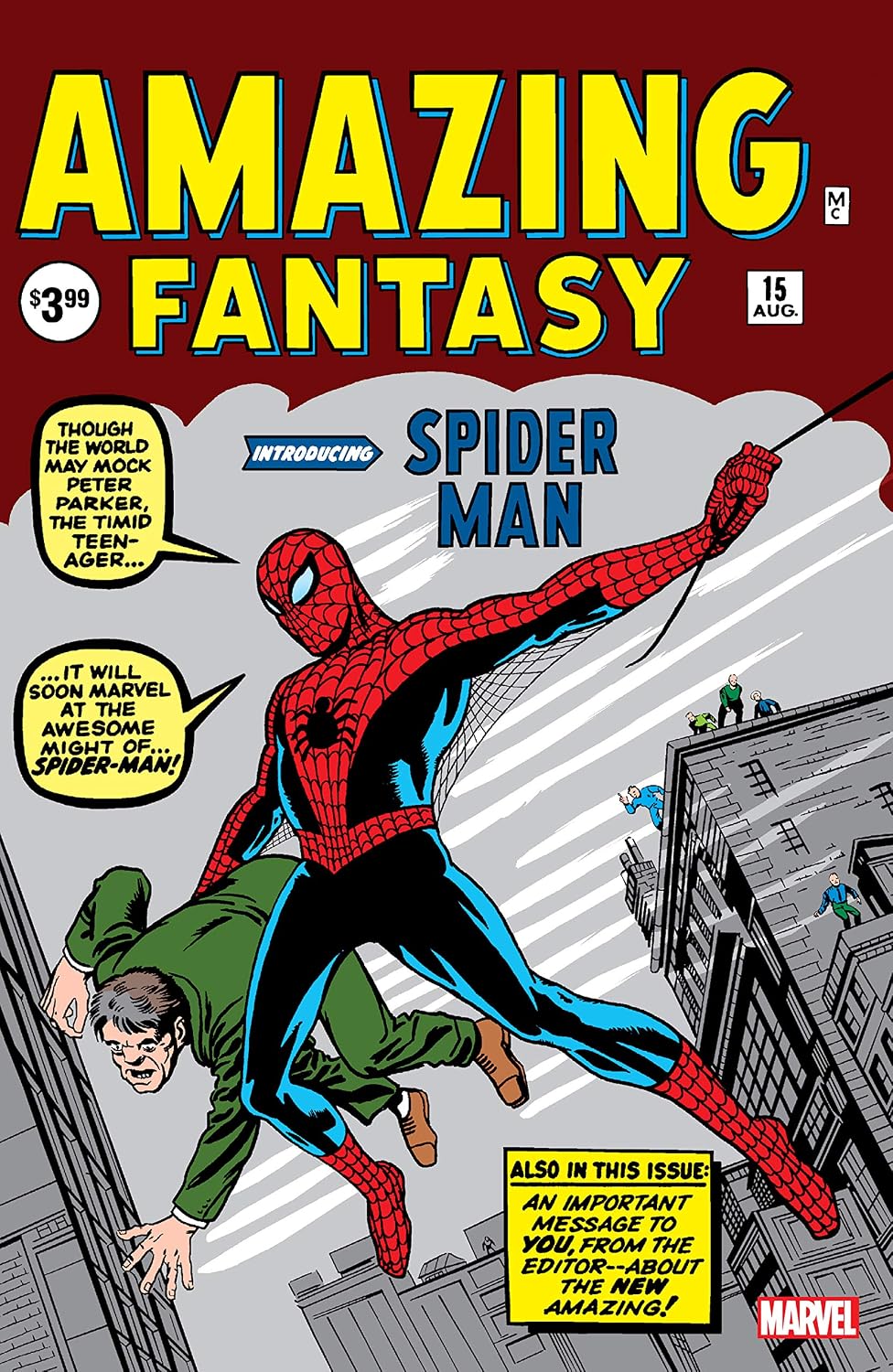
The character first appeared in Amazing Fantasy #15, with a cover date of August 1962.
The issue was written by Stan Lee and illustrated by Steve Ditko.
Stan Lee’s Inspiration
Stan Lee’s basic idea was to create a teenage superhero.
This was already unusual.
The traditional approach would have been to create a young sidekick.
Instead, Lee wanted the teenager to be the central character.
Lee also wanted the character to be someone with whom readers could identify.
The hero would not be a confident adult who had already mastered life.
He would be a teenager dealing with ordinary problems.
Marvel’s official history states that Lee’s inspiration came from wanting to depict an adolescent hero who was not merely a sidekick.
The name “Spider-Man” was also deliberately chosen to sound unusual.
Lee was interested in the idea of a hero associated with an animal that many people found unpleasant or frightening.
As Marvel’s account describes it, Lee found spiders “spooky,” which contributed to the concept.
The character was therefore built around a striking contrast.
Spiders were often associated with fear.
Spider-Man would transform that fear into a source of power.
Steve Ditko’s Contribution
Steve Ditko’s contribution to Spider-Man was enormous.
His artwork established the character’s visual identity.
The Spider-Man costume was radically different from the costumes of many superheroes of the period.
It was:
- Full-body
- Masked
- Covered in web patterns
- Visually mysterious
- Designed around a spider motif
The costume concealed Peter Parker’s identity completely.
This was important because the character was not simply a teenager who put on a colorful costume.
Spider-Man looked almost alien.
His body language was also distinctive.
Ditko drew Spider-Man as:
- Agile
- Flexible
- Acrobatic
- Capable of clinging to walls
- Constantly in motion
Spider-Man did not simply stand in a heroic pose.
He crouched.
He twisted.
He moved like an insect or an animal.
This visual style became one of the character’s defining features.
The Influence of Earlier Characters
Spider-Man did not emerge from nowhere.
The character was influenced by earlier fictional heroes.
One important influence was the tradition of pulp heroes and masked crime fighters.
Characters such as The Shadow demonstrated the popularity of mysterious masked heroes.
There were also earlier comic-book characters with animal themes.
The idea of a hero based on an insect or spider was not entirely new.
However, Spider-Man combined several different traditions:
- The masked mystery hero
- The science-fiction origin story
- The teenage character
- The superhero
- The wisecracking adventurer
- The ordinary person with extraordinary abilities
The character’s originality came from the combination.
The Spider Bite
The origin story of Spider-Man was simple.
Peter Parker was a high-school student.
He was intelligent but socially awkward.
During a demonstration involving radiation, he was bitten by a radioactive spider.
The bite gave him extraordinary abilities.
Peter developed:
- Superhuman strength
- Agility
- Reflexes
- The ability to cling to walls
- A danger sense
He also created his famous web-shooters.
The scientific details of the origin would later be changed and reinterpreted in various versions of the character.
But the basic story remained remarkably consistent.
An ordinary teenager was transformed by an extraordinary event.
The crucial point was that the transformation did not automatically make Peter a hero.
The Central Moral of Spider-Man
The most important event in the original story is not the spider bite.
It is the death of Uncle Ben.
After receiving his powers, Peter initially uses them for personal gain.
He does not immediately become a superhero.
He participates in a wrestling exhibition.
He sees an opportunity to use his powers to make money.
Later, Peter encounters a criminal.
He chooses not to intervene.
His reasoning is essentially that the criminal’s problem is not his responsibility.
The criminal later kills Uncle Ben.
Peter discovers that the man responsible is the same criminal he had previously allowed to escape.
The experience transforms Peter.
The famous moral principle associated with Spider-Man emerges from this story:
With great power comes great responsibility.
This was a major difference between Spider-Man and many earlier superheroes.
The story was not simply about acquiring superpowers.
It was about learning responsibility.
Peter Parker’s greatest failure occurs before he becomes a true hero.
Peter Parker Was the Real Innovation
Spider-Man was visually striking.
The costume was memorable.
The powers were exciting.
But the character’s greatest innovation was Peter Parker.
Peter was not simply the person behind the mask.
In many ways, the struggle between Peter Parker and Spider-Man was the central story.
Peter had problems that superheroes traditionally did not have.
He worried about:
- School
- Money
- Family
- Friends
- Romance
- Social embarrassment
- His reputation
He could defeat a supervillain and still have a terrible day.
He could save someone’s life and then worry about missing a school assignment.
He could defeat criminals but be criticized by the newspaper editor J. Jonah Jameson.
This was a fundamentally different approach to the superhero.
“The Hero Who Could Be You”
Spider-Man was designed to be relatable.
A reader might not be able to imagine becoming Superman.
Superman was an alien from another planet.
Batman was a wealthy adult with extraordinary resources.
Thor was a god.
Iron Man was a brilliant adult industrialist.
Peter Parker was different.
He was a teenager.
He had problems.
He was often uncertain.
He was not socially successful.
He was not wealthy.
He was not naturally confident.
The character’s appeal came from the idea that the superhero was not a perfect person.
Peter Parker had to learn how to be a hero.
This was one of Marvel’s most important innovations.
Spider-Man Was Not Always Popular
The creation of Spider-Man was not universally welcomed within Marvel.
There are longstanding accounts that publisher Martin Goodman was initially skeptical about the idea.
The concern was understandable.
The character seemed to violate several traditional assumptions about superheroes.
He was:
- A teenager
- A loner
- Socially awkward
- Associated with a creature many people feared
- Not traditionally handsome or glamorous
- Burdened by personal problems
The idea of a superhero called Spider-Man may not have sounded like an obvious commercial success.
The fact that his first appearance was placed in Amazing Fantasy was also significant.
The series was nearing the end of its publication.
The character was effectively being given an opportunity in a comic that was not expected to continue for very long.
This meant that Spider-Man could be tried without the same level of risk associated with launching an entirely new ongoing series.
The First Appearance
Spider-Man’s first story appeared in Amazing Fantasy #15. (Amazon affiliate link)
The issue presented the basic story that would define the character:
- Peter Parker is bitten by a radioactive spider
- He gains extraordinary abilities
- He initially uses them for personal benefit
- Uncle Ben is killed
- Peter accepts responsibility
- He becomes Spider-Man
It was a complete origin story.
The issue did not simply introduce a new character and leave readers waiting for the conclusion.
It told a full story.
The combination of:
- Action
- Tragedy
- Humor
- Teenage problems
- A moral lesson
was unusual.
Marvel’s own historical account describes the issue as a genre-defining first appearance that quickly established Spider-Man’s appeal.
The Initial Reception
Spider-Man was a success.
The response to Amazing Fantasy #15 was strong enough that Marvel quickly gave the character his own series.
The Amazing Spider-Man #1 appeared in 1963.
This was a crucial moment.
Spider-Man was no longer a one-time experiment.
He had become a continuing character.
The early series developed the world around Peter Parker.
Important characters included:
- Aunt May
- J. Jonah Jameson
- Betty Brant
- Flash Thompson
- Liz Allan
Spider-Man also developed a memorable collection of villains.
These included:
- The Vulture
- Doctor Octopus
- The Sandman
- The Lizard
- Electro
- Mysterio
- The Green Goblin
- Kraven the Hunter
The villains were important because they were not simply interchangeable monsters.
They became part of Peter Parker’s personal world.
Spider-Man’s Relationship with the Public
One of the most interesting aspects of early Spider-Man was that the public did not always like him.
J. Jonah Jameson, editor of the Daily Bugle, regularly attacked Spider-Man.
Jameson viewed him as:
- A menace
- A masked vigilante
- A dangerous figure
- A publicity seeker
This created an unusual situation.
The reader knew that Spider-Man was generally trying to do the right thing.
But the world inside the comic book often misunderstood him.
This helped create a sense of tension.
Spider-Man could save people and still be criticized.
He could be a hero and still be unpopular.
Again, this made him more relatable.
How Spider-Man Was Different
Spider-Man differed from many superheroes of the period in several important ways.
He Was a Teenager
This was perhaps the most important difference.
Teenagers had usually been sidekicks.
Spider-Man was the main hero.
He Had Ordinary Problems
Peter Parker had to deal with school, family, money, and social problems.
These issues were not merely background details.
They were central to the story.
He Was Not Perfect
Peter made mistakes.
He could be selfish.
He could be immature.
He had to learn responsibility.
He Was Funny
Spider-Man frequently made jokes while fighting.
This was partly a psychological defense mechanism.
The humor also distinguished him from many serious superheroes.
The wisecracking Spider-Man became one of the most recognizable aspects of the character.
He Was Not Always Admired
The public within the story often misunderstood him.
This was unusual for a superhero.
His Powers Were Visually Distinctive
Spider-Man’s movement created an entirely different visual language.
He climbed walls.
He swung through the city.
He moved with extraordinary agility.
The character was perfectly suited to dynamic comic-book artwork.
Spider-Man and the Marvel Universe
Spider-Man was also part of the developing Marvel Universe.
He existed in the same fictional world as:
- The Fantastic Four
- The Hulk
- Thor
- Iron Man
- The Avengers
This allowed Spider-Man to interact with other heroes.
However, he did not fit comfortably into every group.
He was often portrayed as a younger and less established hero.
This reinforced his outsider status.
He might encounter the Fantastic Four or other heroes but still remain fundamentally alone.
His relationships with other superheroes became an important part of the Marvel experience.
The Early Stories Were More Ambitious Than They Appeared
The early Spider-Man stories were often entertaining adventures.
But they also explored serious themes.
The stories dealt with:
- Responsibility
- Guilt
- Grief
- Isolation
- Identity
- Reputation
- Family
Peter Parker was a superhero, but his stories often focused on ordinary human emotions.
This was one of the reasons the character connected with readers.
The superhero action attracted readers.
The emotional story kept them interested.
Was There Evidence of the Future Phenomenon?
The short answer is yes—but the scale of Spider-Man’s future success would have been difficult to predict.
The first sign was the success of Amazing Fantasy #15.
The character was quickly given his own series.
That alone demonstrated that Marvel believed there was commercial potential.
The early sales of The Amazing Spider-Man also confirmed that the character had an audience.
The series became one of Marvel’s most important titles.
However, no one could have easily predicted that Spider-Man would eventually become a global cultural icon.
At the time, Marvel itself was still a relatively small publisher.
The company was building a new superhero universe.
Spider-Man was one successful character among several important new creations.
Yet Spider-Man possessed qualities that made him unusually adaptable.
He could work in:
- Comic books
- Animation
- Television
- Film
- Video games
- Toys
- Merchandise
The basic concept was also universal.
A young person feels:
- Different
- Insecure
- Misunderstood
- Burdened by responsibility
Spider-Man represents the idea that a person with ordinary problems can still do extraordinary things.
That idea has enormous cultural power.
The Significance of Spider-Man’s Youth
One of the most important long-term consequences of Spider-Man was the transformation of the teenage superhero.
After Spider-Man, it became increasingly common for superheroes to be:
- Teenagers
- Young adults
- Students
The character helped demonstrate that young people could be central figures in superhero stories.
This influenced later characters and teams, including:
- The X-Men
- The New Teen Titans
- The New Mutants
- Numerous young superhero characters
The idea of the young superhero was not invented by Spider-Man.
However, Spider-Man helped make it commercially and creatively central to the superhero genre.
The Importance of the Early Spider-Man Stories
The early years established almost everything that would make Spider-Man successful.
The character had:
- A memorable origin
- A distinctive costume
- A recognizable set of powers
- A strong moral foundation
- A complex personal life
- A memorable supporting cast
- An impressive group of villains
The essential formula was established very quickly.
The character could grow and change while still remaining recognizable.
This was one of the great strengths of the original concept.
The Lasting Appeal of Spider-Man
Why has Spider-Man remained so popular?
Part of the answer is the character’s flexibility.
Spider-Man can be interpreted as:
- A superhero
- A science-fiction character
- A coming-of-age story
- A comedy
- A tragedy
- A story about responsibility
Different generations can discover different aspects of the character.
Children may be attracted to the costume and powers.
Teenagers may identify with Peter Parker’s social problems.
Adults may recognize the themes of responsibility, loss, and difficult choices.
The character can therefore grow with the audience.
Conclusion
Spider-Man was created at a crucial moment in the history of Marvel Comics.
The company was emerging from a period in which superheroes had declined in popularity.
Marvel was beginning to rebuild the genre through characters who were more human, flawed, and emotionally complicated.
Stan Lee and Steve Ditko created a character who was unlike most superheroes of the time.
Spider-Man was a teenager rather than an adult.
Peter Parker was not wealthy, confident, or socially successful.
He had to deal with school, money, family, grief, and responsibility.
He made mistakes.
He was often misunderstood.
He also made jokes while fighting supervillains.
The character first appeared in Amazing Fantasy #15 in 1962.
His appearance in a comic that was nearing cancellation might have seemed like an unlikely beginning for one of the most successful fictional characters in history.
Yet the early response was strong enough to earn Spider-Man his own series.
The character quickly became one of Marvel’s most important creations.
There was evidence from the beginning that Spider-Man was special.
His first story was memorable.
His character was unusual.
His personal problems made him relatable.
His visual design was distinctive.
But the scale of the phenomenon that Spider-Man would become could not have been predicted.
The Spider-Man of 1962 was a teenage superhero created for a changing comic-book market.
The Spider-Man of today is a global cultural icon.
The reason for that transformation lies in the character’s central idea:
Anyone can be given extraordinary abilities. The real challenge is deciding what to do with them.
That idea has allowed Spider-Man to remain relevant for more than six decades.
He may be one of the most powerful superheroes in the world.
But at his core, he is still Peter Parker—a young person trying to do the right thing while struggling with the ordinary problems of life.