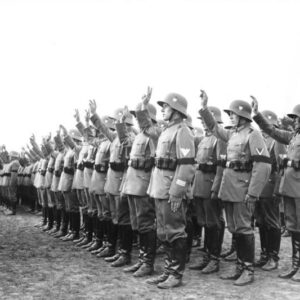
The Rifles of the German Army in World War Two
The German Army of World War Two was renowned for its military innovations, strategic tactics, and advanced weaponry. Among its arsenal, rifles played a critical role in equipping soldiers for combat across Europe, North Africa, and the Eastern Front. This post examines the key rifles used by the Wehrmacht, exploring their design, capabilities, and impact on the battlefield.
1. Karabiner 98k (Kar98k)

Overview
The Karabiner 98k, commonly known as the Kar98k, was the standard-issue rifle for the German Army throughout the war. It was a bolt-action rifle derived from the earlier Gewehr 98, which had been the primary rifle of the German Army during World War One.
Specifications
- Caliber: 7.92x57mm Mauser
- Action: Bolt-action
- Magazine Capacity: 5 rounds (internal magazine)
- Effective Range: 500 meters (800 meters with optics)
- Weight: Approximately 4.1 kg
Features
The Kar98k was known for its reliability, accuracy, and robust construction. It featured a shortened barrel compared to its predecessor, making it easier to handle in the fast-paced and varied environments of World War Two. It was equipped with iron sights and could be fitted with a telescopic sight for use as a sniper rifle.
Role on the Battlefield
The Kar98k was versatile and used in a wide range of roles, from standard infantry engagements to sniper operations. However, as the war progressed and combat became more dynamic, its slow rate of fire compared to semi-automatic and automatic weapons became a disadvantage.
2. Gewehr 43 (G43)

Overview
The Gewehr 43, also known as the G43, was Germany’s response to the increasing demand for semi-automatic rifles on the battlefield. Introduced in 1943, it was designed to provide greater firepower and faster follow-up shots compared to the bolt-action Kar98k.
Specifications
- Caliber: 7.92x57mm Mauser
- Action: Semi-automatic, gas-operated
- Magazine Capacity: 10 rounds (detachable box magazine)
- Effective Range: 500 meters
- Weight: Approximately 4.4 kg
Features
The G43 was based on lessons learned from earlier designs like the Gewehr 41 (G41) and incorporated a gas-operated system for improved reliability. It could also be equipped with a Zf4 telescopic sight for sniper use.
Role on the Battlefield
The G43 was primarily issued to elite units and marksmen due to its limited production numbers. While it was a significant improvement in terms of firepower, it was never produced in sufficient quantities to replace the Kar98k as the standard rifle.
3. Sturmgewehr 44 (StG 44)
Overview
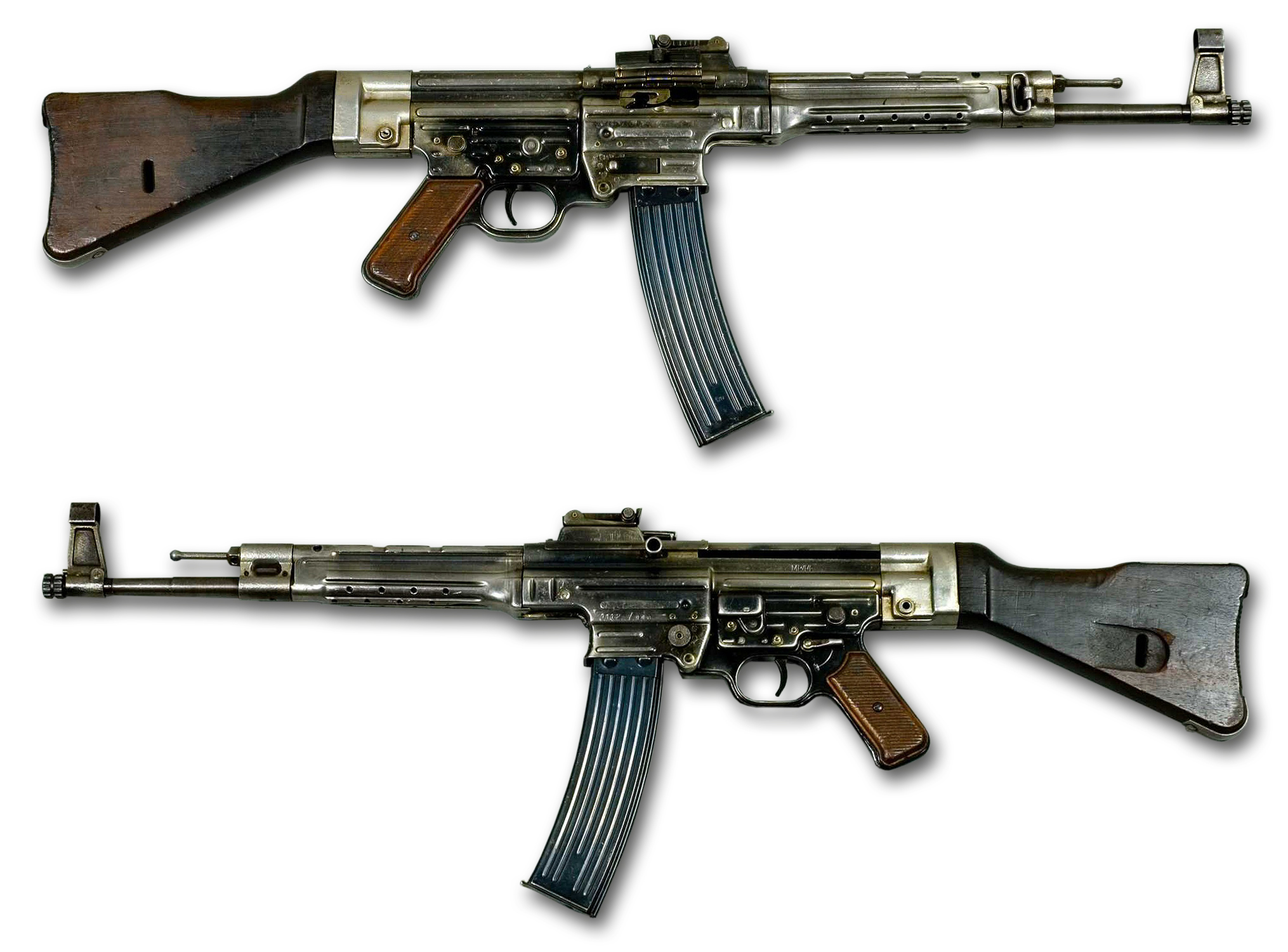
The Sturmgewehr 44 (StG 44), often considered the world’s first modern assault rifle, represented a revolutionary leap in infantry weapon design. Introduced in 1944, it combined the firepower of a submachine gun with the range and accuracy of a rifle.
Specifications
- Caliber: 7.92x33mm Kurz
- Action: Selective fire (semi-automatic and fully automatic)
- Magazine Capacity: 30 rounds (detachable box magazine)
- Effective Range: 300-600 meters
- Weight: Approximately 5.2 kg
Features
The StG 44 used an intermediate cartridge (7.92x33mm Kurz), which provided manageable recoil while delivering effective firepower at medium ranges. Its selective-fire capability allowed soldiers to switch between semi-automatic and fully automatic modes depending on the situation.
Role on the Battlefield
The StG 44 was highly effective in close to medium-range combat, making it ideal for the dynamic and fluid battlefields of late World War Two. However, like the G43, it was produced in limited numbers and did not see widespread distribution.
4. Volkssturmgewehr

Overview
The Volkssturmgewehr (“People’s Assault Rifle”) was a late-war effort to arm the German militia (Volkssturm) with a simplified and inexpensive weapon. Introduced in 1944, it was designed for mass production with limited resources.
Specifications
- Caliber: 7.92x33mm Kurz
- Action: Semi-automatic
- Magazine Capacity: 30 rounds
- Effective Range: Approximately 300 meters
- Weight: Around 4.6 kg
Features
The Volkssturmgewehr was a crude yet functional rifle, built with stamped metal parts and simplified mechanisms to reduce manufacturing costs. It was not particularly durable but served its purpose as a last-ditch weapon.
Role on the Battlefield
Issued to poorly trained militia units, the Volkssturmgewehr was a symbol of Germany’s desperation in the final stages of the war. While not a game-changer, it provided some firepower for the defense of the homeland.
Conclusion
The rifles used by the German Army during World War Two reflect the evolution of infantry weapons in response to the changing demands of modern warfare. From the reliable Kar98k to the innovative StG 44, these firearms played a critical role in shaping the German soldier’s experience on the battlefield. While some designs were groundbreaking, limitations in production and resources ultimately hindered their impact.