


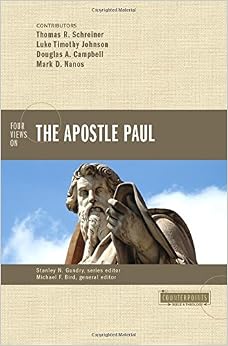
 Michael F. Bird (ed.). Four Views on the Apostle Paul (Grand Rapids: Zondervan, 2012), 236 pp. Pbk.
One of the most interesting series of books to come out is that of the four views. Each book provides the opportunity for multiple authors to offer their own view on a theological subject and then to have each author interact with the opposing views. There have been such books on numerous theological subjects and so it is appropriate that one would be published dealing with the apostle Paul. The four views that are offered in this volume is that of Thomas R. Schreiner (Reformed), Luke Timothy Johnson (Catholic), Douglas A. Campbell (Post-New Perspective) and Mark D. Nanos.
Thomas Schreiner presents a view that is probably the most recognizable to readers of this journal. Schreiner argues for a Christ-centered theology for Paul. Everything from soteriology to ecclesiology has Jesus as its focus. Schreiner argues strongly for a substitionary atonement and for forensic righteousness being applied to believers. Schreiner argues against the term pistis Iēsou Christou being translated as “faithfulness of Christ” and for the traditional translation of “faith in Christ.”
Luke Timothy Johnson offers a view that has much in common with Schreiner’s view. Like Schreiner, Johnson accepts all of the Pauline letters in the New Testament as authentic. Johnson primarily argues for salvation as a liberation and transformation effected by the death and resurrection of Jesus. The salvation that is offered is one that has both a present and future aspect. Johnson sees the role of the church as the place where the work of Christ reconciling humanity to God takes place.
While the Reformed and Catholic perspectives are recognizable, some readers may be confused by the term “Post-New Perspective.” What Douglas Campbell means by Post-New Perspective is that he accepts the New Perspective’s reevaluation of Judaism but rejects the adjustment in Paul’s understanding of justification. Campbell takes the bold move of focusing almost completely on Romans 5-8 in describing Paul’s theology. Campbell suggests that Paul’s soteriology is rather inclusive and that Christ undoes what Adam did, not just for the church, but for all of humanity.
Mark Nanos presents the Jewish view of the apostle Paul. This may surprise some that there is even a Jewish view. Jews often see Paul as someone who caused many of the problems between Jews and Christians. Nanos attempts to redeem Paul for Jews by placing him firmly within first century Judaism. Paul was not a Jew who converted to Christianity but was someone who remained within Judaism all his life, despite acknowledging Jesus as the Messiah. Nanos understands Paul’s main controversy as being about not requiring Gentiles to go through proselyte conversion. Paul still expected Jewish followers of Jesus to live like Jews and for non-Jews to adapt their lifestyle in order to have fellowship with the Jewish community that would one day be known as Christianity.
While a review should point out the weaknesses of a book, in this case it is not as necessary as each author critiques the other views. I will say that Thomas Schreiner and Luke Timothy Johnson’s presentations are the most convincing. Douglas Campbell has some good things to say but his over-reliance on Romans 5-8 is disappointing and his argument for inclusivism is not convincing. Mark Nanos’ Jewish interpretation is interesting and informative but less than convincing. My main criticism of the book is that I would have preferred seeing a New Perspective author rather than a Post-New Perspective Author.
Four Views on the Apostle Paul continues the fine tradition of the four views books. There is much to be learned, both by where the authors agree and where they disagree. Michael Bird has done a comendable job in editing this volume. I plan to use this book as supplemental text for courses that I teach with regard to the letters of Paul.
Stephen J. Bedard