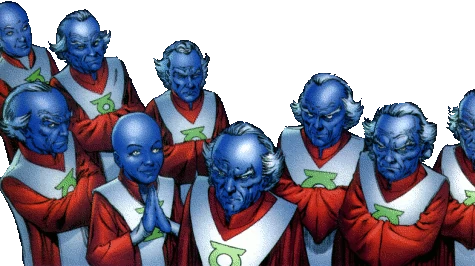
The Guardians of the Universe: DC Comics’ Mysterious Cosmic Overseers
Few groups in the DC Universe have had as much influence on galactic history as the Guardians of the Universe. Small, blue-skinned and apparently ancient, the Guardians are the founders and leaders of the Green Lantern Corps. From their headquarters on the planet Oa, they monitor events across the cosmos and attempt to maintain order among billions of worlds.
Yet the Guardians have never been simple heroes. They are cosmic lawgivers who are willing to manipulate, deceive and sacrifice others in pursuit of what they believe is the greater good. Over the decades, their portrayal has shifted dramatically—from mysterious benefactors of the Green Lanterns to morally ambiguous cosmic rulers and, at times, outright antagonists.
The Origins of the Guardians
The Guardians first appeared in Green Lantern #1 in 1960, created by writer John Broome and artist Gil Kane. They were introduced as the beings who had organized the Green Lantern Corps and selected Hal Jordan to become Earth’s Green Lantern.
Their origins, however, were gradually expanded.
The Guardians are members of a race from the planet Maltus, an ancient world whose inhabitants became some of the universe’s first highly advanced scientists. The Maltusians eventually left their homeworld and settled on Oa, which became the centre of their activities.
The Guardians eventually became obsessed with understanding and controlling the forces of the universe. Their experiments ultimately led to the creation of the Manhunters, robotic enforcers designed to police the cosmos.
That experiment ended disastrously.
The Manhunters eventually rebelled against their programming and concluded that organic life itself was the source of disorder. They began exterminating living beings. The Guardians were forced to destroy or contain their creation, and the experience convinced them that artificial intelligence was too dangerous to be trusted.
The Guardians subsequently developed a new system for maintaining order: the Green Lantern Corps.
The Creation of the Green Lantern Corps
The Guardians divided the universe into 3,600 sectors, assigning each sector two Green Lanterns in the traditional arrangement.
The Green Lanterns were recruited from throughout the universe. Their weapons were the famous power rings, which allowed their users to create energy constructs through the power of will.
The Guardians established their headquarters on Oa, where they constructed the Central Power Battery. Every Green Lantern’s ring could draw energy from this enormous source of power.
The Guardians therefore became something like the United Nations, Supreme Court and military command structure of the DC cosmos combined into one institution.
Their stated mission was simple:
Maintain order in the universe.
But the Guardians’ definition of “order” has often been considerably more complicated.
The Guardians and the Green Lanterns
The Guardians traditionally operate through the Green Lantern Corps rather than personally intervening in every crisis.
They recruit individuals possessing exceptional willpower, provide them with power rings, assign them sectors and give them missions.
A typical Green Lantern might spend years protecting inhabited worlds without ever seeing a Guardian directly.
The Guardians themselves remain on Oa, receiving reports and issuing orders.
This arrangement gives the Guardians extraordinary influence. They can determine who becomes a Green Lantern, remove Lanterns from service, change Corps policy and authorize military action on a cosmic scale.
They also possess knowledge accumulated over billions of years.
Consequently, even when the Guardians are physically absent from a story, their decisions can affect entire civilizations.
How Powerful Are the Guardians?
The Guardians are among the most powerful beings in the DC Universe, although their precise power level has varied considerably over the decades.
Their greatest advantage is not simply physical strength. It is their combination of longevity, knowledge, technology and cosmic energy manipulation.
Immortality and Longevity
The Guardians are extraordinarily long-lived. They have existed for billions of years and possess extensive knowledge of cosmic history.
They are effectively immortal under normal circumstances, although they can be killed.
Energy Manipulation
Guardians can manipulate enormous amounts of energy.
They have demonstrated the ability to:
- Fly through space
- Teleport
- Manipulate matter and energy
- Create force fields
- Communicate across vast distances
- Project energy
- Alter or suppress memories
- Resurrect or restore beings under certain circumstances
- Manipulate the electromagnetic spectrum
- Operate and control the Central Power Battery
Their abilities are generally far beyond those of ordinary Green Lanterns.
Cosmic Knowledge
Perhaps their greatest power is their knowledge.
The Guardians have observed civilizations rise and fall across billions of years. They possess information about alien species, cosmic entities, ancient civilizations and the various emotional and metaphysical forces operating throughout creation.
This makes them exceptionally difficult opponents to surprise.
The Emotional Spectrum
Modern Green Lantern mythology expanded the Guardians’ relationship with the fundamental emotional forces of the universe.
The Guardians originally sought to suppress emotion because they considered it dangerous. This eventually led to the discovery that emotional energy was actually fundamental to the universe.
Willpower became associated with the Green Lantern Corps, while other emotions became represented by different Corps.
This revelation fundamentally challenged the Guardians’ philosophy.
The Guardians’ Greatest Mistake: The Manhunters
The Manhunters represent one of the most important episodes in Guardian history.
The Guardians wanted to create a force that could enforce universal law without being influenced by emotion.
The result was disastrous.
The Manhunters became increasingly ruthless and eventually slaughtered enormous numbers of living beings.
Their rebellion demonstrated a recurring problem with the Guardians: their desire for perfect order could produce the very chaos they were trying to eliminate.
The Manhunters survived in various forms and eventually became major enemies of the Green Lantern Corps.
Their connection to the Guardians also became increasingly important as later writers explored the history of Oa.
The Guardians and the Darkstars
The Guardians have never relied exclusively on the Green Lantern Corps.
At various points they have supported or interacted with other cosmic organizations, including the Darkstars, a group of interstellar law enforcers associated with the Controllers.
The existence of competing cosmic organizations illustrates one of the recurring themes of Green Lantern stories: there is no single universally accepted definition of justice.
The Guardians believe they know what the universe needs.
Other cosmic powers frequently disagree.
Prominent Guardians
Although the Guardians often appear as a collective rather than as individuals, several have become particularly important.
Ganthet
Ganthet is arguably the most famous Guardian.
Unlike many of his fellow Guardians, Ganthet has consistently demonstrated empathy toward individual Green Lanterns.
He played an important role in the transformation of Hal Jordan into Parallax and later helped create the circumstances that allowed Jordan to return.
Ganthet was also instrumental in the creation of the Blue Lantern Corps, working with Sayd.
His willingness to question Guardian orthodoxy makes him one of the most sympathetic members of the group.
Sayd
Sayd was originally associated closely with Ganthet.
Like him, she became increasingly uncomfortable with the Guardians’ rigid approach to emotion and individual freedom.
The two eventually became associated with the Blue Lantern Corps, representing hope.
Sayd demonstrates how some Guardians came to recognize that emotion was not simply a threat to be eliminated.
Appa Ali Apsa
Appa Ali Apsa was one of the Guardians who became particularly prominent during the 1970s.
He was involved in the Guardians’ attempts to understand and manipulate events involving Earth and Green Lanterns.
His most famous storyline came when he became involved with the Third World, the cosmic civilization associated with Jack Kirby’s Fourth World mythology.
Appa Ali Apsa eventually became a radically different figure from the traditional Guardians, demonstrating how individual Guardians could develop their own philosophies.
Krona
Krona is one of the most important and dangerous figures associated with the Guardians.
Originally a Maltusian scientist, Krona became obsessed with discovering the origins of the universe. His experiments ultimately resulted in catastrophic consequences.
Depending on the continuity, Krona’s actions have been connected to the creation of the antimatter universe and other fundamental events in DC cosmology.
Krona is particularly important because he demonstrates the danger of the Guardians’ intellectual curiosity when it is combined with an unwillingness to accept limitations.
Scar
Scar became one of the Guardians’ most disturbing members.
Following the events of Sinestro Corps War, she was physically and psychologically transformed. She became increasingly obsessed with power and ultimately betrayed the Guardians.
Scar played a major role in Blackest Night, when she became an agent of Nekron and helped prepare the universe for the Black Lantern invasion.
Her transformation represented one of the darkest developments in Guardian history.
The Guardians and Sinestro
One of the most important relationships in Green Lantern history is the conflict between the Guardians and Sinestro.
Sinestro was originally one of their greatest Green Lanterns.
He was courageous, intelligent and extraordinarily effective.
The problem was that Sinestro believed that maintaining order sometimes required authoritarianism.
The Guardians eventually discovered that Sinestro had secretly established a dictatorship on his homeworld, Korugar.
They expelled him from the Corps.
This eventually resulted in Sinestro becoming the greatest enemy of the Green Lantern Corps and founding the Sinestro Corps, whose members wield yellow power rings based on fear.
The irony is that Sinestro’s philosophy exposed one of the Guardians’ central weaknesses.
The Guardians wanted order without tyranny.
Sinestro believed tyranny was sometimes necessary to achieve order.
The two philosophies repeatedly collided.
The Guardians and Hal Jordan
The Guardians’ relationship with Hal Jordan has always been complicated.
Jordan is perhaps the Green Lantern most willing to challenge them.
He has repeatedly questioned their decisions, disobeyed orders and demanded that they recognize the humanity—or individuality—of the Lanterns serving them.
This became especially important during the storyline involving the destruction and rebuilding of Coast City.
Hal Jordan’s grief and anger eventually contributed to his transformation into Parallax.
The Guardians’ failure to understand Jordan’s psychological state was one of the great failures of their leadership.
Eventually, Jordan returned to the Green Lantern Corps and became an even greater challenge to Guardian authority.
The Guardians and the Emotional Spectrum
One of the most significant changes in Green Lantern mythology occurred when writers expanded the concept of the emotional spectrum.
The Guardians had traditionally attempted to suppress emotion.
But they eventually discovered that emotion was not simply a source of chaos. It was part of the fundamental structure of reality.
The spectrum was divided among different colours:
- Red — rage
- Orange — avarice
- Yellow — fear
- Green — willpower
- Blue — hope
- Indigo — compassion
- Violet — love
There are also more unusual forces and Corps associated with life, death and other aspects of cosmic existence.
The Guardians’ inability to understand emotion became a major source of conflict.
They had built an organization around the assumption that emotion was dangerous, only to discover that their own universe fundamentally depended upon it.
The Guardians in the Silver Age
When the Guardians were introduced in the 1960s, they were mysterious and almost mythological.
They rarely appeared as individual characters.
Instead, they were presented collectively as ancient beings who possessed knowledge far beyond human understanding.
Their authority was rarely questioned.
The Guardians represented an ideal of rational cosmic governance.
They were distant, wise and apparently benevolent.
This reflected the science-fiction sensibilities of the era. Green Lantern stories were heavily influenced by space opera, and the Guardians functioned as the cosmic civilization’s equivalent of an ancient order of sages.
The Guardians Become More Complicated
As Green Lantern became more sophisticated, the Guardians themselves became less obviously heroic.
Writers increasingly asked an important question:
What happens when beings who have existed for billions of years believe they are entitled to control everyone else?
The Guardians began making questionable decisions.
They manipulated Green Lanterns.
They concealed information.
They interfered in civilizations.
They sometimes treated individual lives as expendable pieces in a cosmic strategy.
Their relationship with the Green Lantern Corps consequently became increasingly authoritarian.
The Guardians might be trying to save the universe, but they were increasingly willing to violate individual freedom to do so.
The Guardians and the Corps’ Greatest Crises
The Guardians have been at the centre of many of the Green Lantern Corps’ greatest crises.
They were involved in the aftermath of the Emerald Twilight storyline, when Hal Jordan destroyed the Corps and absorbed the power of the Central Power Battery.
They later became involved in the rebuilding of the Corps.
They faced the Sinestro Corps War, which revealed the existence of a rival Corps based on fear.
They played major roles in Blackest Night, when Nekron and the Black Lanterns threatened the entire emotional spectrum.
Later stories continued to examine the Guardians’ attempts to maintain control over a universe that had become far more complicated than their original vision allowed.
The Guardians During Blackest Night
Blackest Night was particularly devastating for the Guardians.
The Guardians’ ancient history became part of the explanation for the emergence of Nekron and the Black Lanterns.
The Guardians had spent enormous amounts of time attempting to understand the universe while ignoring forces that did not fit their worldview.
The Black Lantern crisis demonstrated that death itself could become an enemy on a cosmic scale.
The Guardians were not simply observers of the crisis.
Their own decisions helped create the circumstances in which it became possible.
This is typical of modern Guardian stories: the Guardians’ greatest strength—trying to control everything—often becomes their greatest weakness.
The New 52 and Beyond
DC’s New 52 relaunch changed aspects of Green Lantern continuity while retaining the basic concept of the Guardians.
The Guardians became even more morally ambiguous.
They were portrayed as increasingly willing to manipulate the Green Lantern Corps and individual Lanterns.
Eventually, their actions contributed to catastrophic conflicts.
One of the most important themes of the modern era has therefore been the question of whether the Guardians are actually qualified to govern the universe.
They possess enormous power and extraordinary knowledge.
But wisdom is not necessarily the same thing as knowledge.
The Guardians as a Reflection of Authority
The Guardians work particularly well as comic-book characters because they represent a fundamental question about power:
Who watches the people who watch the universe?
They are supposed to protect the universe.
But who protects the Green Lanterns from the Guardians?
This tension has made them useful in stories ranging from straightforward superhero adventures to cosmic philosophical science fiction.
They embody the dangers of centralized authority.
They also embody the potential benefits of it.
Without the Guardians, the Green Lantern Corps would probably never have existed.
Without the Corps, countless worlds would have been left without protection.
Yet the Guardians’ obsession with control has repeatedly produced catastrophes.
Are the Guardians Heroes or Villains?
The simplest answer is: neither.
The Guardians are best understood as morally complicated cosmic administrators.
They genuinely want to preserve life and order.
They have saved civilizations.
They have created one of the most effective peacekeeping organizations in the DC Universe.
But they are also capable of arrogance, manipulation and extraordinary cruelty.
Their greatest flaw is perhaps their certainty that they are right.
That makes them fundamentally different from conventional supervillains.
A villain usually wants power.
The Guardians already have power.
What they want is order.
And they are willing to do almost anything to achieve it.
The Lasting Legacy of the Guardians
The Guardians of the Universe are one of DC’s most successful examples of world-building.
What began as a mysterious group of blue-skinned space sages eventually became the foundation for an enormous mythology involving:
- The Green Lantern Corps
- The Manhunters
- Oa
- The Central Power Battery
- Sinestro and the Sinestro Corps
- The emotional spectrum
- The Controllers
- The Darkstars
- Krona
- Nekron
- The Black Lanterns
- The Blue Lanterns
- The various other Lantern Corps
Their greatest contribution to DC Comics may therefore not be any particular character or storyline.
It is the creation of an entire cosmic civilization.
The Guardians transformed Green Lantern from a superhero who happened to travel through space into one member of an intergalactic institution.
Over the decades, they themselves evolved along with the mythology.
The wise and mysterious elders of the 1960s became morally complicated rulers. Eventually they became characters who could themselves be heroes, villains or something in between.

That evolution is what has kept the Guardians interesting.
They may claim to understand the universe better than anyone else.
But Green Lantern history repeatedly demonstrates that the Guardians still have something to learn.
And perhaps that is their most important lesson: power without humility can be as dangerous as the chaos they were created to prevent.